Whistleblower warns Postal Service's new mail ballot system has "potentially catastrophic problems" - CBS News
The Post
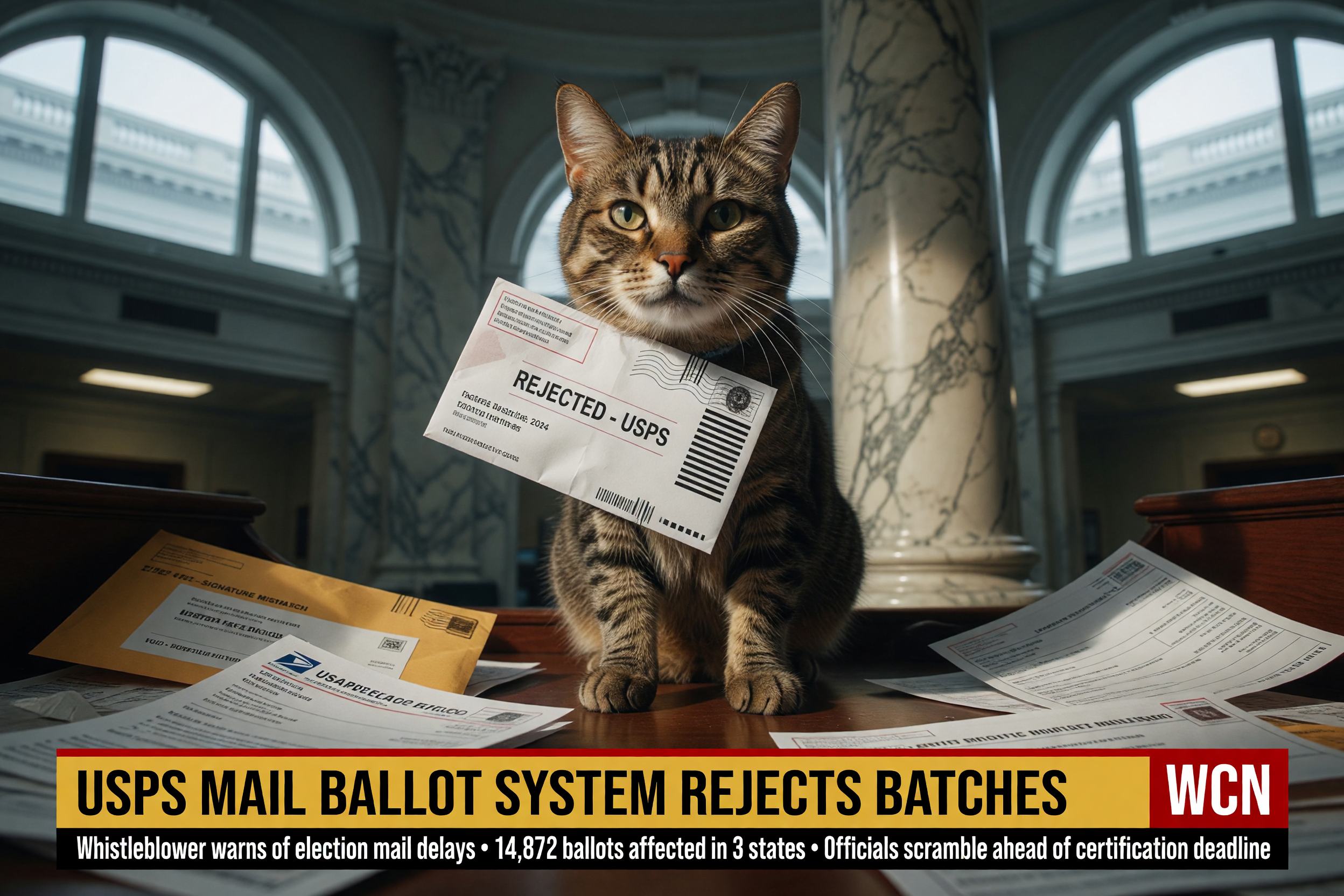
What Walter Read
Meta-Analysis Brief
Suggested post type: REPORT — Six outlets reported the same whistleblower disclosure but with materially different emphases—defied-court-orders (Axios), secrecy (NYT), voter impact (WaPo), 'derail'/timing (NPR), technical chaos (CNN), and hedged 'if courts allow it' caution (NBC)—and they diverge on the litigation status, so a coverage-comparison post serves readers better than a straight REPORT. The heavy lean-left tilt of the source pool and the absence of the primary documents make the framing analysis the load-bearing story.
Consensus Facts
- An anonymous federal official, represented by the nonprofit Whistleblower Aid, filed a disclosure alleging serious problems with the U.S. Postal Service's new mail ballot verification system.
- The disclosure was submitted to Democratic Sen. Richard Blumenthal of Connecticut, who sent it to Postmaster General David Steiner in a letter dated Monday and made it public this week.
- The system stems from an executive order President Trump signed in March directing the federal government to generate lists of eligible U.S. citizens and requiring USPS to transmit ballots only to voters on state-submitted lists.
- USPS finalized a rule last month laying out the new mail-voting requirements, which was published in the Federal Register.
- Under the system, state election officials must submit voter names, addresses, and unique ballot envelope barcodes to a new online federal portal; USPS scans ballot envelopes and checks them against this data.
- If even a single ballot barcode in a batch (cited as roughly one bad ballot in a batch of 10,000) fails to scan or match, the entire batch is rejected and returned to state officials.
- The whistleblower alleges the system was rushed—built in weeks or a few months rather than the nine to twelve months normally needed for a project of this complexity.
- A federal judge issued a temporary block/restraining order against USPS's plan last week, and the Justice Department/administration has appealed that decision.
- The whistleblower's lawyers characterized the process as 'entirely unforgiving,' warning it could delay thousands of ballots in repeated verification cycles and prevent states from mailing enormous numbers of ballots.
- 23 Democratic-led states plus Washington, D.C. have sued the administration to challenge Trump's executive order.
- USPS and the White House did not respond to requests for comment by the time of publication.
- Trump has claimed mail-in voting fraud justifies the changes, has himself voted by mail, and his administration has not put forward evidence of widespread fraud (studies and audits show noncitizen voting is extremely rare).
Disagreements
Framing Analysis
Primary Source Alignment
- No primary source (the whistleblower disclosure, Blumenthal's letter, the USPS final rule, or the court orders) was provided in the dossier; alignment cannot be independently verified against the underlying documents.
- All full-text outlets quote the same disclosure language—'entirely unforgiving,' 'feature rather than a bug,' and the 10,000-ballot batch-rejection example—suggesting these are direct quotes from the Whistleblower Aid disclosure rather than independent reporting.
- Because the disclosure, letter, and rule were not retrievable, the brief relies entirely on outlets' characterizations of these documents; readers should note the whistleblower's claims are allegations, not adjudicated findings.
- No outlet obtained a response from USPS or the White House; the agency's side of the technical readiness claims is entirely absent.
- The whistleblower is anonymous and represented by an advocacy nonprofit (Whistleblower Aid); no outlet independently verified the technical claims about build timelines or testing periods.
- The disclosure was released by a Democratic senator amid active partisan litigation; outlets note this context but none scrutinize the political timing of the release relative to the mailing deadlines.
- All full-text outlets in the dossier are lean-left (CBS, NPR, NBC, CNN) or specialized (Axios); no right-leaning or center outlet body text is present, limiting the framing matrix.
- Six of seven outlets are lean-left and two of the most detailed (NYT, Washington Post) are headline-only, so the richest technical claims (four-day testing, 'manifests,' June start date) rest on single-outlet reporting each.
- No outlet quantifies how many states currently intend to voluntarily use the portal versus those refusing, which would clarify the real-world scale of potential disruption.
- The specific state ballot-mailing deadlines (North Carolina 'this week' per CNN) are mentioned in passing but not systematically laid out, obscuring how imminent any impact would be.
Verification Gate Results
All verification checks passed.
Draft Analysis
No factual issues found.
Story Selection
15 candidates detected, 14 passed triage
Selected: Whistleblower warns Postal Service's new mail ballot system has "potentially catastrophic problems" - CBS News
Source: news_fetcher