Lindsay Clancy Trial Live Updates: Deadlocked Jury Tries Again to Reach a Verdict - The New York Times
The Post
Lindsay Clancy's jury reported a second deadlock in six days of deliberations. Judge Sullivan issued a Tuey-Rodriguez instruction urging continued effort, NBC News and USA Today report. The jury: nine women, three men.
And that's the mews.
And that's the mews.
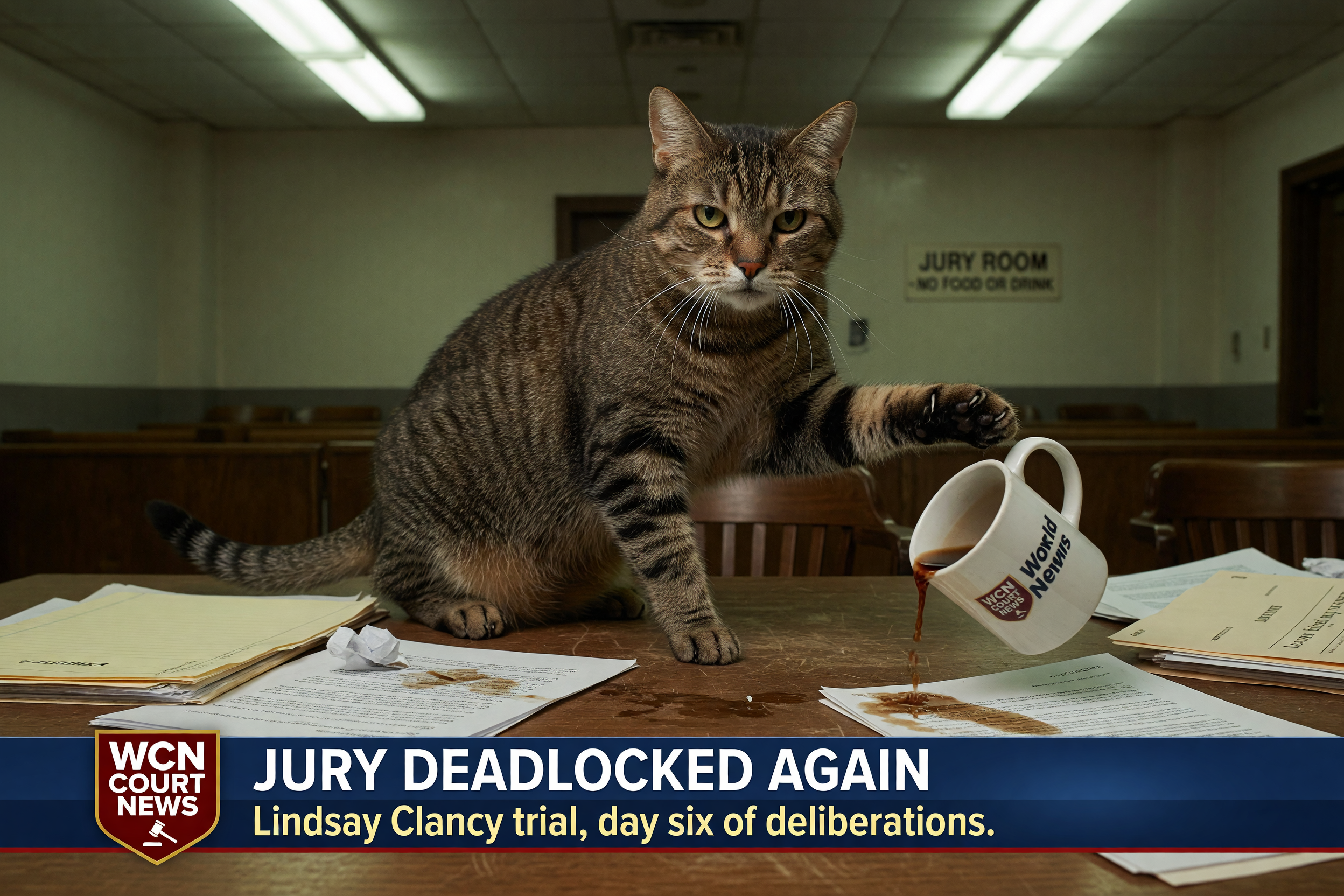
What Walter Read
Reuters
Wire Service
Headline Only
NBC News
Lean Left
Full Text
The New York Times
Lean Left
Headline Only
ABC News
Lean Left
Full Text
CBS News
Lean Left
Full Text
CNN
Lean Left
Full Text
USA Today
Lean Left
Full Text
Meta-Analysis Brief
Suggested post type: REPORT — Five outlets covered the same ongoing deadlock but with materially different emphases — NBC on the juror-removal dispute, USA Today on the 'dynamite instruction' plus side stories, ABC/CNN on mistrial mechanics via legal analysts — making this a coverage-comparison story rather than a straight REPORT, especially since no verdict outcome or primary source is available.
Consensus Facts
- The jury in Lindsay Clancy's murder trial deliberated without reaching a unanimous verdict, with deliberations extending into a sixth day (NBC News, ABC News, CBS News, CNN, USA Today).
- The jury reported being deadlocked a second time before Judge William Sullivan gave a Tuey-Rodriguez instruction (also called a 'dynamite instruction' or Allen-type charge) urging them to keep trying to reach a verdict (NBC News, ABC News, USA Today).
- The jury is composed of nine women and three men (NBC News, USA Today).
- Clancy is charged in the January 2023 strangulation deaths of her three children — Cora, 5; Dawson, 3; and Callan, 8 months (NBC News, USA Today).
- After the killings, Clancy attempted suicide by jumping from a second-story window, leaving her paralyzed (NBC News, USA Today).
- The defense, led by attorney Kevin Reddington, argues Clancy lacks criminal responsibility due to postpartum psychosis and does not deny that she killed the children (NBC News, USA Today).
- Prosecutors allege Clancy planned the killings, including sending her husband out on errands, and strangled the children with exercise bands (NBC News, USA Today).
- If the jury cannot reach a verdict, Judge Sullivan will declare a mistrial, after which prosecutors must decide whether to retry Clancy (NBC News, ABC News, USA Today, CNN).
- Reddington told reporters he expected prosecutors to retry the case if a mistrial is declared and said the defense would be ready (NBC News, USA Today).
Disagreements
Length/scope of deliberations reported
ABC News: States the jury deliberated 30 hours over five days without a verdict.
USA Today: Frames deliberations as beginning Aug. 27 after testimony from more than 80 witnesses, stretching into a sixth day; does not cite the 30-hour figure.
NBC News: Describes 'nearly five days of deliberations' without an hour count.
Location of the courthouse / family home
NBC News: Refers to the courthouse in Plymouth, Massachusetts.
USA Today: Identifies the family's home as being in Duxbury, Massachusetts.
Nature of the Thursday jury question and defense response
NBC News: Reports a specific Thursday development: the jury submitted a question apparently about reasonable doubt, the judge repeated his reasonable-doubt instruction, and the defense moved to remove a juror who allegedly 'refuses to listen to the law,' which the judge declined to do.
ABC News: Does not report the Thursday juror-removal dispute; focuses on Wednesday's Tuey-Rodriguez instruction and next steps.
USA Today: Does not report the juror-removal motion; focuses on Sept. 2 developments and a separate jury-intimidation arrest.
CNN: Frames the story around the fifth day ending without a verdict; no mention of the juror dispute.
CBS News: Video-only summary noting deliberations resumed on the sixth day; no juror-removal detail.
Framing Analysis
Reuters
Headline-only in the dossier. Neutral wire framing: 'Deadlocked jury ... deliberates for sixth day.' No body text available to assess emphasis.
NBC News
Most detailed body text. Leads on the defense's motion to remove a juror and the judge's refusal, foregrounding courtroom conflict and Reddington's animated behavior (waving papers, wheeling Clancy to sidebar). Emphasizes procedural stakes (only two send-backs allowed before a mistrial) and lays out the full range of possible verdicts, including lesser charges. Frames Clancy sympathetically via description of her being 'upset' then 'stoic.'
The New York Times
Headline-only in the dossier. Framing signaled by the question-headline 'Can the Lindsay Clancy Jury Break Its Deadlock?' — treats the deadlock as the central drama. No body text available to assess emphasis.
ABC News
Leads on the 30-hour, five-day deadlock and pivots quickly to a 'what happens next' explainer, leaning on outside legal analysts (Peter Elikann, Brian Buckmire) to walk through mistrial mechanics and possible bail/retrial. Frames the moment as 'the final push.'
CBS News
Video-driven local (Boston/WBZ) coverage. Minimal reporting text; frames the story simply as deliberations resuming on the sixth day without a verdict. Surrounding video list emphasizes the mistrial angle and draws a comparison to the Karen Read case.
CNN
Brief video item from Anderson Cooper 360. Frames the fifth day ending without a verdict and leans on legal analyst Elie Honig characterizing the jury as 'on the brink of a hung jury and a mistrial.' Emphasis is on the drama of imminent deadlock rather than case substance.
USA Today
Leads on the 'dynamite instruction' and explains the Tuey-Rodriguez charge in depth via a Northeastern law professor (Daniel Medwed). Provides the fullest case background (witness count, Duxbury home, pleas) and uniquely surfaces two side stories: an explicit comparison to the Karen Read case (also a hung jury, later retried and acquitted) and the arrest of Dawn Light for alleged juror intimidation. Includes a suicide-resource advisory, signaling sensitivity framing.
Primary Source Alignment
- No primary sources (court filings, transcripts, orders) were located for this story, so no direct document-to-coverage comparison is possible.
- Direct quotes from Judge Sullivan's Tuey-Rodriguez/reasonable-doubt instructions appear in NBC News and USA Today, but these are reported courtroom quotes, not verified primary-source excerpts in the dossier.
Missing Context
- No outlet in the dossier reports the actual outcome of the sixth day of deliberations — whether a verdict or mistrial ultimately resulted. Coverage stops at the point of ongoing deadlock.
- Only two outlets (NBC News, USA Today) provide substantial case background; the Reuters and New York Times entries are headline-only and cannot corroborate specifics.
- The precise content of the jury's Thursday note is not disclosed — NBC infers it 'may have been regarding reasonable doubt' but the judge did not read it aloud, leaving the basis of the deadlock unverified.
- No outlet quantifies how the jury is split (e.g., which way the majority leans or numerical division), and Judge Sullivan explicitly noted there is 'no way to determine what the deliberations are.'
- Prosecutors' actual intentions on retrial are sourced only to defense attorney Reddington's characterization ('Tim Cruz will never drop it'); NBC notes prosecutors themselves have not indicated whether they would retry.
- The Dawn Light juror-intimidation arrest is reported only by USA Today; no other outlet corroborates it, and its resolution (Oct. 15 pretrial hearing) is pending.
- No apparent instruction-injection attempts were detected in any article body; all content read as ordinary news reporting.
Verification Gate Results
PASSED
All verification checks passed.
Draft Analysis
CLEAN
No factual issues found.
Story Selection
15 candidates detected, 14 passed triage
Selected: Lindsay Clancy Trial Live Updates: Deadlocked Jury Tries Again to Reach a Verdict - The New York Times
Source: news_fetcher