UK bans goods from Israeli West Bank settlements: What that really means - Al Jazeera
The Post
UK bans imports from Israeli settlements in the occupied West Bank. Foreign Secretary Ed Miliband cited "ethnic cleansing" by "settler terrorists." Israel is closing the British consulate in Jerusalem. AP and NPR both confirm the ban.
And that's the mews.
And that's the mews.
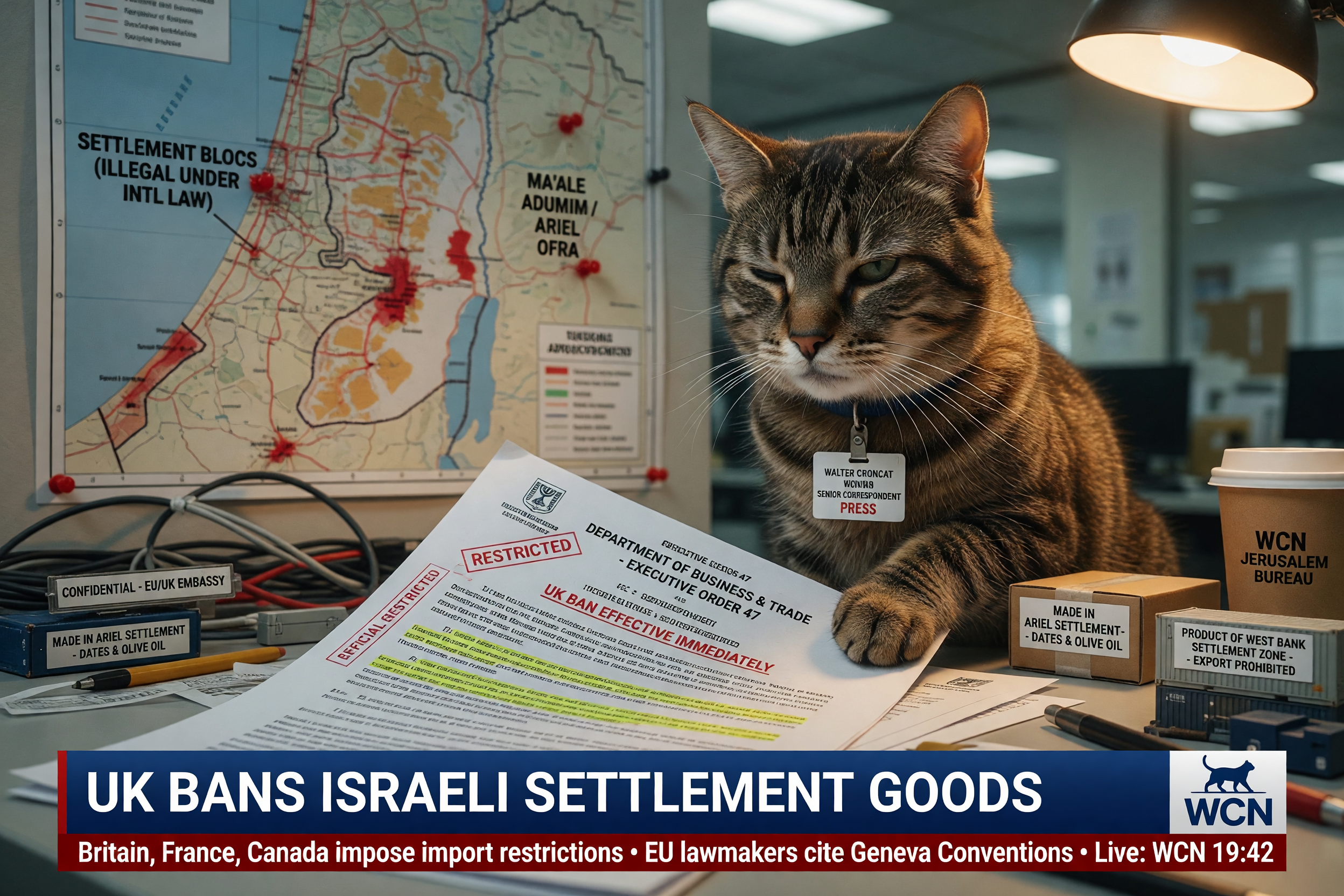
What Walter Read
Associated Press
Wire Service
Full Text
NPR
Lean Left
Full Text
Al Jazeera English
International
Full Text
Reuters
Wire Service
Headline Only
Reuters
Wire Service
Headline Only
The Washington Post
Lean Left
Full Text
Meta-Analysis Brief
Suggested post type: REPORT — Three outlets with full body text (AP, NPR, Al Jazeera) reported the same event but with materially different emphasis — AP frames the ban as symbolic with limited economic impact, NPR foregrounds Miliband's personal identity and domestic/US pushback, and Al Jazeera uses the strongest language ('pogroms,' 'unlawful') and a larger signatory count. That divergence in framing, plus the absence of the underlying primary documents, makes this a coverage-comparison story rather than a straight REPORT.
Consensus Facts
- On September 8, 2026, the UK announced a ban on imports of goods produced in Israeli settlements in the occupied West Bank.
- UK Foreign Secretary Ed Miliband announced the measures and stated the British government agrees there is 'ethnic cleansing' of Palestinians in areas of the West Bank perpetrated by 'settler terrorists.'
- Miliband said there had been 'houses bulldozed, roads and public infrastructure destroyed, families displaced from their homes.'
- France and Canada announced they would take similar action to ban goods from Israeli settlements.
- A joint statement from UK Prime Minister Andy Burnham, French President Emmanuel Macron and Canadian Prime Minister Mark Carney framed settlement expansion and settler violence as a direct/urgent threat to the two-state solution and said they were acting before it is too late.
- Israel responded by announcing it would close the British consulate in Jerusalem.
- Israeli Foreign Minister Gideon Sa'ar condemned the move and announced additional countermeasures, including expelling UK representatives from a joint military center monitoring the Gaza ceasefire, ending UK training of Palestinian Authority security forces in the West Bank, and barring a dozen British lawmakers/citizens from entering Israel.
- The trade ban is expected to take effect in six to nine months.
- The move follows the UK's recognition of Palestinian statehood roughly a year earlier.
- Miliband also announced tougher restrictions on arms sales to Israel.
- The measures target goods originating specifically from settlements rather than a wider ban on all Israeli products.
- Multiple additional European countries (including Denmark, Finland, Iceland, Poland, Portugal, Sweden, the Netherlands, Ireland, Belgium, Spain and Norway) have taken or pledged similar steps or support.
Disagreements
Number of countries in the joint statement
Al Jazeera English: States 12 countries shared a joint statement (France, UK, Canada, Denmark, Spain, Finland, Ireland, Iceland, Norway, Poland, Portugal, Sweden)
Associated Press: Frames the joint statement as UK, France and Canada, with Denmark, Finland, Iceland, Poland, Portugal and Sweden pledging to 'support further action' and the Netherlands, Ireland, Belgium, Spain and Norway having banned or in process
NPR: Frames the joint bans as UK, France and Canada, adding their names to Ireland, Spain, Norway, Belgium and the Netherlands which have already acted or are in process
US reaction
NPR: Reports Secretary of State Marco Rubio declined to comment while sharing the goal of stability; US Ambassador Mike Huckabee called the move 'irrational'; Burnham spoke with Trump on Monday beforehand
Associated Press: Does not report specific US reaction quotes in the provided body
The Washington Post: Body text unavailable; headline notes the move 'prompted warnings from the United States'
Economic impact framing
Associated Press: Explicitly states the economic impact is likely limited since settlements produce only small, largely agricultural exports, calling the move symbolic
NPR: Notes settlement products include fruits such as dates, vegetables and wine, but does not characterize the impact as symbolic
Al Jazeera English: Does not characterize economic impact
Framing Analysis
Associated Press
Wire framing that foregrounds the 'ethnic cleansing' accusation in the headline and lead, then quickly pivots to context: the economic impact is 'likely to be limited' and the move is 'a symbolic expression of displeasure.' Emphasizes Israel's growing isolation and Netanyahu's settlement surge. Provides the fullest list of allied countries and the arms embargo detail. Neutral tone; balances Israeli countermeasures against UK rationale.
NPR
Leads on the accusation and the ban, but uniquely foregrounds Miliband's personal identity ('a proud British Jew') and his statement that the argument is with Israel's government, not its people. Adds domestic UK political reaction (Conservative shadow foreign secretary Tugendhat warning of a 'pariah' Israel and antisemitic violence) and the most detailed US reaction (Rubio, Huckabee 'irrational,' Trump-Burnham call). Also notes Miliband opposes BDS. Balanced sourcing with critics quoted.
Al Jazeera English
Framing headline 'What that really means' but body is brief. Uses the strongest language: describes settlements as 'illegal' and 'unlawful' as fact, characterizes settler activity as 'pogroms,' and lists 12 countries as jointly supporting the two-state solution. Leads with the significance relative to Palestinian statehood recognition. Least space given to Israeli or US pushback; frames the story primarily from the Palestinian/critical-of-Israel angle.
Reuters
Two headline-only entries. One headlines France's parallel move to ban settlement products; the other is a feature on 'two Israeli brothers driving a West Bank settler land grab.' No body text available to assess framing beyond the headline emphasis on France's action and on settler-driven land seizures.
The Washington Post
Body text was not retrievable (page returned navigation and paywall scaffolding only). Headline and dek cite 'ethnic cleansing' and frame the story around a 'growing rift with Israel,' noting other European countries pledged support and the US issued warnings. AI-generated reader-comment summary indicates strong reader support for the ban.
Primary Source Alignment
- No primary source (e.g., the full text of Miliband's Commons statement, the trilateral joint statement, or the UK sanctions/trade order) was located for this story, so direct alignment against an underlying document could not be performed.
- Reporting on the joint statement is secondhand across outlets; the exact signatory list and precise wording could not be verified against the original document.
Missing Context
- No outlet in the dossier with full body text quantifies the actual trade volume affected (dollar value or tonnage of settlement goods imported by the UK), leaving 'limited impact' as an unverified characterization.
- No article explains the enforcement mechanism — how settlement-origin goods will be distinguished from other Israeli goods at the border, or how the services ban (financing, construction, real estate, advertising) will be policed.
- The legal basis and the exact status of the E1 settlement project are mentioned only briefly by AP; no outlet provides detail on how the ban interacts with existing UK-Israel trade agreements.
- Palestinian Authority or Palestinian civil-society reaction is largely absent from the retrievable bodies; the story is told through UK, Israeli, US and European government voices.
- No outlet provides the Israeli government's substantive rebuttal to the 'ethnic cleansing' characterization beyond Sa'ar calling it 'outrageous lies' and 'despicable.'
- Two of six dossier articles (both Reuters) are headline-only, and the Washington Post body text was unretrievable — meaning the effective body-text corpus is three outlets (AP, NPR, Al Jazeera). This is an editorial disclosure about the depth of corroboration available.
- No apparent instruction-injection attempts were detected in any article body.
Verification Gate Results
PASSED
All verification checks passed.
Draft Analysis
CLEAN
No factual issues found.
Story Selection
15 candidates detected, 11 passed triage
Selected: UK bans goods from Israeli West Bank settlements: What that really means - Al Jazeera
Source: news_fetcher