Trump Slams Supreme Court Over Mail-In Voting Ruling - The New York Times
The Post
#BreakingMews: The Associated Press reports Trump publicly attacked the Supreme Court on Tuesday after it rejected his push to restrict mail-in voting ahead of the 2026 midterms. Justices Thomas and Alito dissented.
reported by Associated Press, not yet confirmed elsewhere.
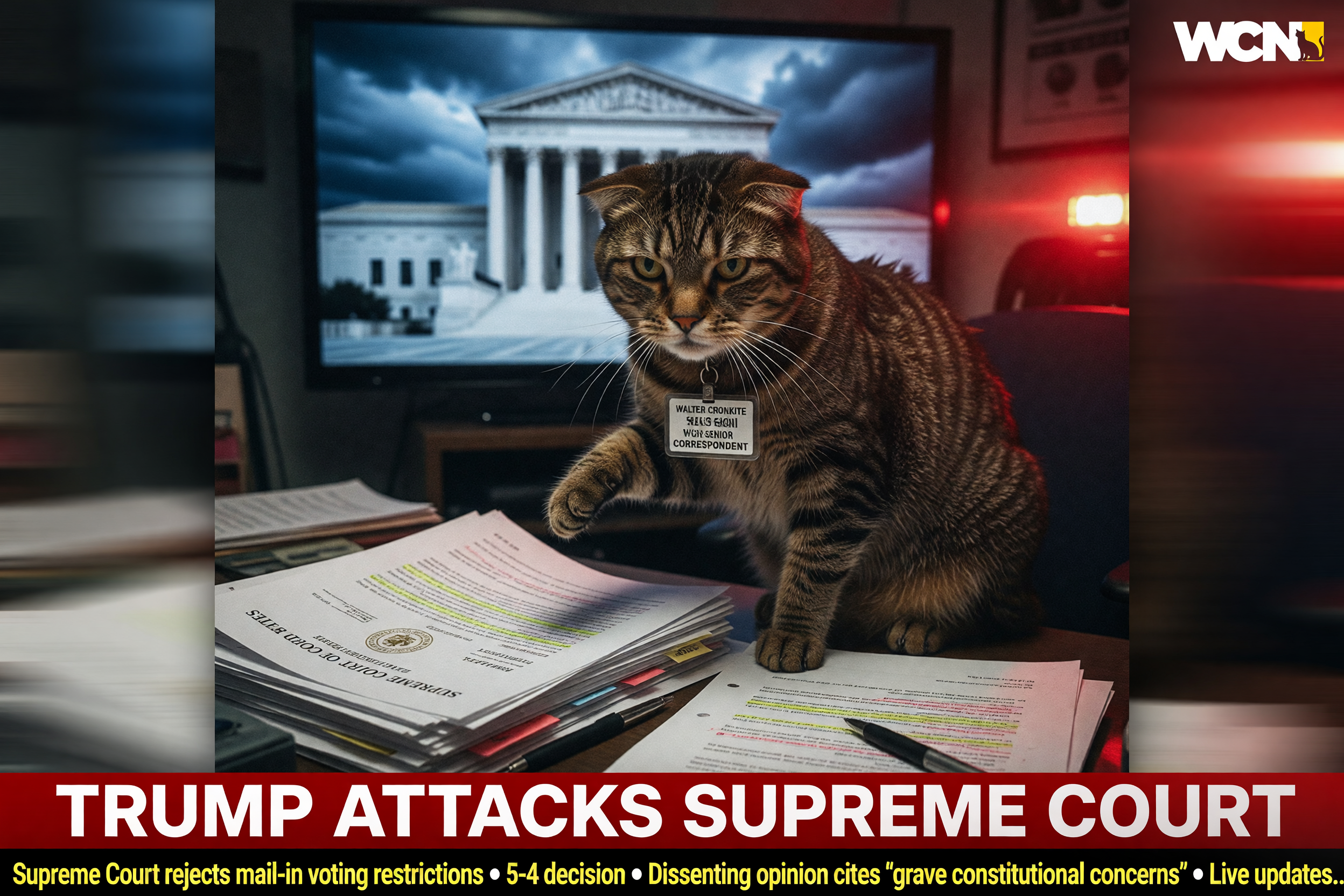
What Walter Read
Associated Press
Wire Service
Full Text
The Washington Post
Lean Left
Full Text
The New York Times
Lean Left
Headline Only
The New York Times
Lean Left
Headline Only
USA Today
Lean Left
Full Text
USA Today
Lean Left
Full Text
The Hill
Center
Headline Only
Meta-Analysis Brief
Suggested post type: REPORT — Multiple outlets covered the same event but foregrounded materially different angles — AP on Trump's pattern of attacking his appointees, USA Today's Cann piece on the ruling as a substantive 'big deal' plus the wider DOJ election campaign, and the Washington Post on 'personal betrayal' — making the divergence in framing, not the bare facts, the story worth surfacing.
Consensus Facts
- The Supreme Court rejected the Trump administration's push to restrict mail-in voting for the November 2026 midterm elections, issuing the order late Monday, Sept. 14.
- On Tuesday, Sept. 15, Trump publicly attacked the Supreme Court over the ruling in a lengthy social media post.
- Trump wrote that 'The Court's inability and unwillingness to do the right thing for our Country will go down, in a very negative way, in the annals of History,' and said the court 'is bullied and cajoled by the Radical Left.'
- The Trump administration had sought to have the U.S. Postal Service play a central role in screening or tightening mail-in ballots.
- Justices Clarence Thomas and Samuel Alito dissented from the order.
- Justice Brett Kavanaugh wrote that making the requested changes so close to the midterms would be 'arbitrary and capricious.'
- The court's majority indicated the administration was unlikely to succeed on the merits of its challenge.
- Roughly 30% (about a third) of voters cast ballots by mail, and mail ballots have already gone out to voters in some states.
- Claims of widespread mail-in voting fraud have been repeatedly debunked.
Disagreements
The vote breakdown
USA Today (Cann article): Reports a specific 5-2 decision.
Associated Press: Does not state a numerical vote count; describes it as an emergency order with two named dissenters.
USA Today (Alund article): Notes two of five conservative justices dissented but does not state the full 5-2 split.
Which of Trump's Truth Social quotes to feature
Associated Press: Leads with the 'not the people I interviewed' quote and 'set America back at least a hundred years.'
USA Today (Alund article): Leads with the 'totally CORRUPT and out of control Mail-In voting disaster' quote.
USA Today (Cann article): Features the 'horrible, highly political, ruling' quote and the 'Dumocrats' cheating language.
The Washington Post: Frames the entire post as Trump portraying the ruling as a 'personal betrayal.'
Underlying district court ruling detail
USA Today (Alund article): Names U.S. District Judge Indira Talwani in Boston, who put the changes on hold as likely unconstitutional.
Associated Press: Does not name the lower court judge; cites state election officials' timing and security arguments.
USA Today (Cann article): References a lower court decision without naming the judge.
Framing Analysis
Associated Press
Neutral wire framing centered on Trump's history of attacking justices he appointed. Leads with the 'not the people I interviewed' quote and contextualizes it against his prior fury over birthright citizenship and tariffs rulings. Includes Attorney General Todd Blanche's statement that the administration will comply. Adds fact-check context citing a 2025 Brookings study (four fraud cases per 10 million mail ballots) and notes Trump falsely blamed mail voting for his 2020 loss.
The Washington Post
Body text largely inaccessible behind a paywall; only headline and dek retrievable. Frames the story around 'his own Supreme Court appointees' and explicitly casts Trump's reaction as a 'personal betrayal,' bundling mail ballots with tariffs and birthright citizenship. The AI-generated reader-comment summary further emphasizes Trump's alleged 'misunderstanding of the judiciary's role.'
The New York Times
Two entries in the dossier are headline-only (no retrievable body). Headlines emphasize both Trump's attack ('Trump Slams Supreme Court Over Mail Ballot Ruling') and the substantive outcome ('Supreme Court Rejects Trump's Restrictions on Voting by Mail'). No body-level framing can be assessed.
USA Today
Two full-text articles with distinct angles. The Alund piece ('attacks Supreme Court') centers Trump's reaction and the mechanics of the order (barcode envelopes, verified voter lists, USPS refusal power) and names Judge Talwani. The Cann piece ('Why that's a big deal') frames the ruling as 'a major blow' to Trump, leads with a specific 5-2 vote, quotes relieved election officials in Utah and Oregon, notes Democrats vote by mail more than Republicans, and details the broader DOJ campaign to assert control over state elections (voter-roll reviews, lawsuits against 30 states, letters demanding records).
The Hill
Body text inaccessible (CAPTCHA wall). Only the headline is retrievable, which foregrounds Trump's 'These are not the people I interviewed to serve' quote. No body-level framing can be assessed.
Primary Source Alignment
- No primary sources (the Supreme Court order, Kavanaugh's opinion, the dissents, Judge Talwani's ruling, or Trump's full Truth Social post) were located for this story, so no direct document-to-coverage comparison is possible.
- Kavanaugh's 'arbitrary and capricious' phrasing is reported consistently across the Associated Press and both USA Today articles, but the underlying opinion text was not available to verify context or scope.
Missing Context
- No primary source was available: the actual Supreme Court order, Kavanaugh's concurrence, the Thomas/Alito dissents, and Trump's full Truth Social post were not in the dossier.
- The Washington Post, The Hill, and both New York Times entries were effectively headline/dek-only (paywall, CAPTCHA, or RSS-stub), so this brief's substantive reporting rests primarily on the Associated Press and two USA Today articles.
- Outlets did not clearly reconcile whether the decision was a 5-2 vote (per USA Today's Cann article) versus simply an emergency order with two dissents (per AP) — the total number of justices participating and the exact alignment of the majority is not consistently established across body-text outlets.
- No outlet detailed the specific legal basis on which Judge Talwani found the order 'likely unconstitutional' beyond timing concerns.
- The precise text and full March executive order requirements (barcode envelope design, USPS authority to refuse non-compliant ballots) appear only in USA Today; other body-text outlets did not corroborate these specifics.
- No outlet provided the administration's counterargument on the merits in detail — only that it argued USPS had authority and that it intended to comply while continuing broader election-control efforts.
Verification Gate Results
PASSED
All verification checks passed.
Draft Analysis
CLEAN
No factual issues found.
Story Selection
15 candidates detected, 11 passed triage
Selected: Trump Slams Supreme Court Over Mail-In Voting Ruling - The New York Times
Source: news_fetcher