Smoke seen near Riyadh airport after air raid alerts in Saudi capital - BBC
The Post
What Walter Read
Meta-Analysis Brief
Suggested post type: REPORT — Three full-text outlets (BBC, CNBC, The Guardian) reported the same Riyadh airport event but with materially different framings — BBC on-the-ground and war-casualty focused, CNBC energy-markets and US-Iran diplomacy focused, The Guardian region-wide and UN-Security-Council focused — and diverge on details like which cities were alerted and which islands were seized. The divergence in emphasis, plus the absence of official confirmation and any primary source, makes this a coverage-comparison story rather than a straight REPORT.
Consensus Facts
- Saudi civil defense issued aerial-attack/air-raid alerts to residents overnight before giving an all-clear the following (Saturday) morning (BBC, CNBC, The Guardian).
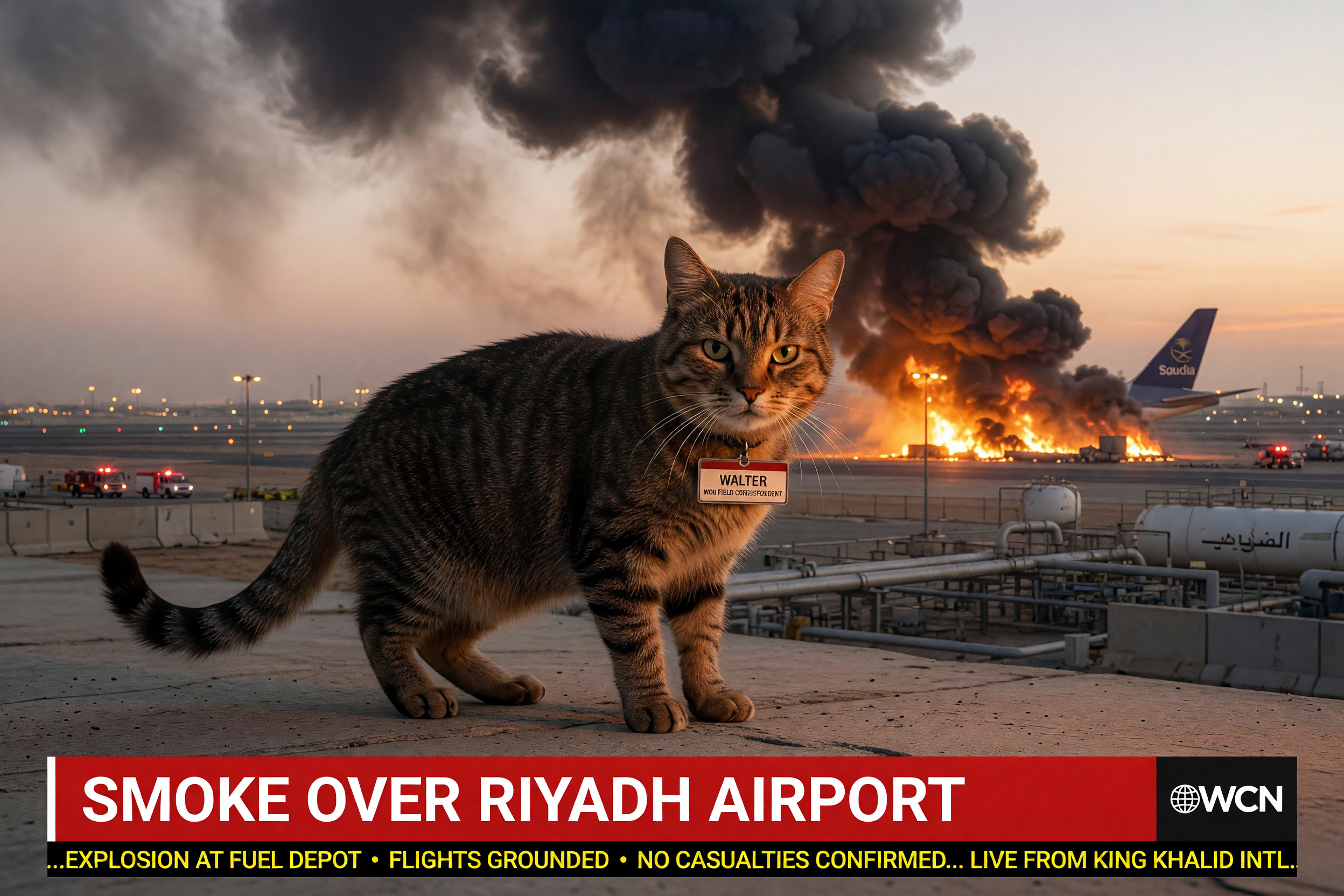
- Flames and a large plume of black smoke were seen near Riyadh's King Khalid International Airport on Saturday, September 19, 2026 (BBC, CNBC, The Guardian).
- Explosions/booms were reported heard in the capital by residents (BBC, CNBC, The Guardian).
- The alert was the first issued for Riyadh since a recent escalation in the conflict with Iran-backed Houthi militants in neighboring Yemen (BBC, The Guardian).
- The smoke was reported to be coming from a burning fuel tank/storage depot bearing the Aramco (Saudi state oil company) logo near the airport (BBC, The Guardian).
- As of reporting, Saudi authorities had not issued official comment on the cause; the cause of the fire was not officially confirmed (BBC, CNBC).
- FlightRadar24 reported major disruption — delays and cancellations — at King Khalid International Airport (BBC, The Guardian).
- Iran-backed Houthi forces have escalated attacks on Saudi Arabia and captured the port of Mokha and Perim Island near the Bab el-Mandeb Strait, a key shipping choke point (BBC, CNBC, The Guardian).
- The IOM (a UN body) reported roughly 105,000 people displaced by recent fighting in Yemen (BBC, The Guardian).
- JP Morgan issued a note saying it was struggling to forecast oil prices due to the war (BBC, CNBC — CNBC frames the war as a US-Iran conflict).
Disagreements
Framing Analysis
Primary Source Alignment
- No primary source was located for this story. No court filings, official Saudi Civil Defense statements, UN Security Council text, IOM report, or JP Morgan note was included in the dossier, so no report-versus-document divergence can be assessed.
- Several load-bearing claims trace to news agencies rather than documents: the eyewitness accounts and burnt-out Aramco fuel tank (AFP per BBC/Guardian; Reuters per CNBC), and the casualty and displacement figures (AFP/IOM). Absent the underlying statements, these remain agency-sourced, not primary-document-verified.
- No outlet obtained on-record confirmation from Saudi authorities on the cause of the airport fire; the fuel-tank-strike explanation rests on an AFP journalist's observation and unnamed residents, not official attribution.
- No outlet definitively links the fire to a Houthi strike — the connection between the overnight air-raid alerts and the airport fire is implied by proximity and timing, not confirmed as cause and effect.
- The dossier has effectively three usable full-text outlets (BBC, CNBC, The Guardian); Reuters and The Times of Israel are headline-only, and both BBC entries are the same article duplicated across bbc.com and bbc.co.uk — so apparent breadth of sourcing is narrower than the seven-article count suggests.
- Casualty and displacement figures are explicitly labeled 'unconfirmed' (BBC) and are drawn from military sources on both sides of the war; no independent verification is offered.
- No outlet quantifies the operational impact on King Khalid International Airport beyond FlightRadar24's disruption index — no figures on stranded passengers, duration of closure, or damage assessment.
- The Times of Israel URL returned a CAPTCHA/verification placeholder rather than article content, so its coverage could not be analyzed beyond the headline.
- No article confirms whether the two BBC URLs represent distinct reporting or a single syndicated piece — treated here as one source to avoid double-counting.
Verification Gate Results
All verification checks passed.
Draft Analysis
No factual issues found.
Story Selection
13 candidates detected, 10 passed triage
Selected: Smoke seen near Riyadh airport after air raid alerts in Saudi capital - BBC
Source: news_fetcher