Trump Allegedly Banned News Outlets After Natalie Harp Showed Him Negative Coverage - Forbes
The Post
Trump announced bans on CNN, MS NOW, and Politico, citing "cumulative stories." TMZ, sourcing the Wall Street Journal, reports aide Natalie Harp showed Trump negative clips that triggered the decision.
And that's the mews.
And that's the mews.
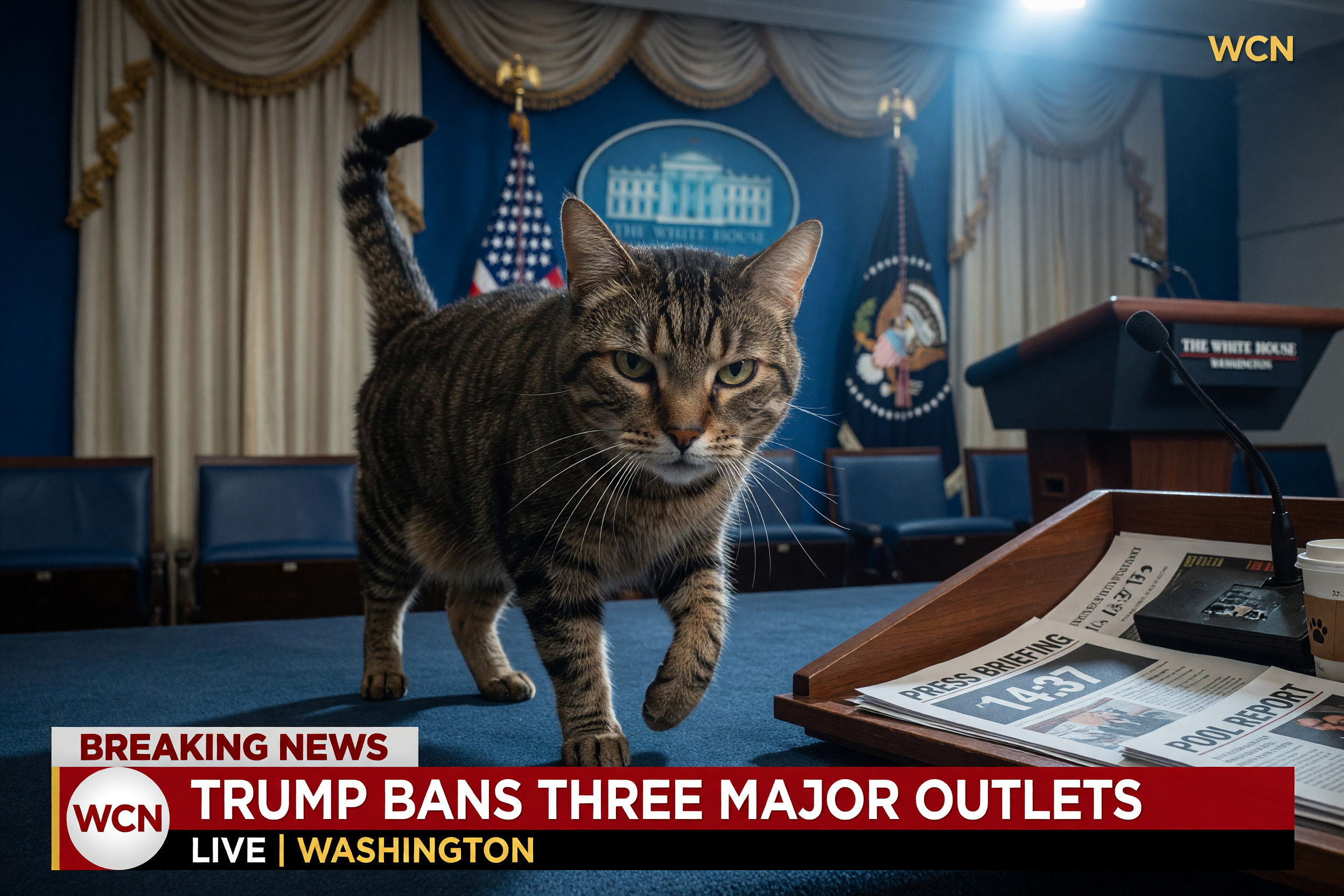
What Walter Read
Bloomberg
Wire Service
Full Text
Forbes
Headline Only
TMZ
Full Text
Forbes
Headline Only
Meta-Analysis Brief
Suggested post type: REPORT — Multiple outlets covered the same event with materially divergent framings — Bloomberg centers the First Amendment/constitutional stakes and omits Harp entirely, while TMZ and the Forbes headlines center the Natalie Harp personal-influence angle sourced to a single WSJ report not in the dossier. The story is fundamentally about how coverage diverges on causation and enforcement, making this a coverage-comparison META rather than a straight REPORT.
Consensus Facts
- President Trump announced he is banning CNN, MS NOW and Politico from the White House, posting on Truth Social that the outlets are 'FAKE NEWS.'
- Trump told reporters the ban was not prompted by a specific incident but was the result of 'cumulative stories over the past few years.'
- CNN, MS NOW and Politico responded by asserting they will defend their First Amendment rights to cover the White House (both Bloomberg and TMZ report the statements from the outlets and their invocation of First Amendment protections).
Disagreements
Role of Natalie Harp in prompting the ban
Bloomberg (wire): Does not mention Natalie Harp at all; attributes the ban to Trump's stated 'cumulative stories' rationale.
TMZ: Reports, citing the Wall Street Journal, that aide Natalie Harp showed Trump negative clips of TV anchors and an unfavorable MS NOW report, which prompted the ban.
Forbes (headline-only): Headline states Trump 'allegedly banned' the outlets after Natalie Harp showed him negative coverage; no body text available to corroborate.
Whether the ban has already taken effect / been enforced
Bloomberg (wire): Frames it as a 'threat' announced Friday, with reporters still working in the White House Friday afternoon and the ban set to take effect Saturday per Fox News citing an unnamed official.
TMZ: States the ban was enforced Saturday, with reporters stopped at the gate, credentials confiscated, and CNN/MS NOW correspondents relegated to the street, and that the three outlets have since sued the administration.
Litigation status
Bloomberg (wire): Does not report that any lawsuit has been filed; notes only that a legal challenge is 'almost certain.'
TMZ: States CNN, MS NOW and Politico 'have since sued the Trump Administration to fight the ban.'
Framing Analysis
Bloomberg (wire)
Leads on the constitutional stakes, framing the move as Trump's 'latest threat to the independent press.' Emphasizes First Amendment analysis, quotes free-speech experts (Freedom of the Press Foundation, Knight First Amendment Institute), and situates the ban within a long pattern of Trump-press conflict (AP ban over Gulf of Mexico, ABC/CBS defamation settlements, Acosta/Karem credential fights). Adds political context — proximity to Nov. 3 midterms, sagging GOP polling, and an unpopular Iran war. Notably omits any mention of Natalie Harp. Neutral wire phrasing; treats the ban as announced/threatened rather than fully enforced.
Forbes (Article 2, headline-only)
Headline foregrounds the Natalie Harp angle and uses the hedge word 'Allegedly,' centering the personal-influence narrative over the institutional/legal story. No body text available to assess emphasis beyond the headline.
Forbes (Article 4, headline-only)
Headline takes a straight, sourced-to-Trump framing ('Trump Says He's Banning...'), attributing the action to Trump's own statement rather than to Harp. No body text available.
TMZ
Leads hard on the personal-drama angle — 'It was all Natalie Harp's fault' — attributing the ban to Harp showing Trump negative clips, sourced to the Wall Street Journal. Emphasizes tabloid-style human interest: Harp's 'undying loyalty,' intimate letters ('You are all that matters to me'), and a Sen. Jon Ossoff callout. Also reports enforcement details (credentials confiscated, reporters on the street) and a subsequent lawsuit that Bloomberg does not mention. Light on constitutional/legal analysis; heavy on personality and gossip framing.
Primary Source Alignment
- No primary sources (court filings, the cited Wall Street Journal report, Trump's Truth Social post in full, or the outlets' full statements) were located in the dossier, so no direct document-to-coverage comparison is possible.
- The Natalie Harp claim is ultimately attributed by TMZ (and the Forbes headline) to the Wall Street Journal, which is not present in the dossier — meaning the origin of that central claim cannot be verified against its source here.
Missing Context
- Only two of four articles have retrievable body text (Bloomberg and TMZ). The two Forbes entries are headline-only and cannot corroborate any body-level detail, including the Natalie Harp claim.
- The Natalie Harp allegation traces to a single underlying report (the Wall Street Journal) that is not in the dossier; TMZ and the Forbes headline appear to derive from that same source, so this is effectively single-sourced, not independently corroborated.
- No outlet in the dossier includes a response or statement from Natalie Harp or the White House addressing the claim that she prompted the ban.
- The exact scope of the ban is not fully clarified — Bloomberg notes the legality depends on scope (press pool vs. broader credential revocation) but the dossier does not specify precisely which access is being revoked.
- TMZ asserts a lawsuit has been filed but provides no case name, court, or filing date; no primary court document is in the dossier to confirm the litigation.
- No neutral or right-leaning outlet with full body text is present to balance the wire (Bloomberg) and tabloid (TMZ) framings, limiting the slant range of verifiable reporting.
Verification Gate Results
PASSED
All verification checks passed.
Draft Analysis
ESCALATION
- attribution (major) — The draft states as fact that Harp's actions 'triggered' the ban, but the sources only 'reportedly' or 'allegedly' connect her to the decision—Trump himself denied any specific triggering incident and cited cumulative coverage instead.
- headline_drift (minor) — The headline seed uses 'allegedly' but the draft moves toward causal certainty ('triggered the decision') when Trump's own statements and the body reporting emphasize cumulative factors rather than Harp's actions as the trigger.
Story Selection
15 candidates detected, 11 passed triage
Selected: Trump Allegedly Banned News Outlets After Natalie Harp Showed Him Negative Coverage - Forbes
Source: news_fetcher