Grand jury declines to bring criminal charges in Nolan Wells death - BBC
The Post
A Jackson County grand jury declined to charge anyone in the death of Nolan Wells, 18, after hearing 43 witnesses. AP and CBS News report the panel found "no credible evidence" of criminal conduct. The cause of death remains undetermined.
And that's the mews.
And that's the mews.
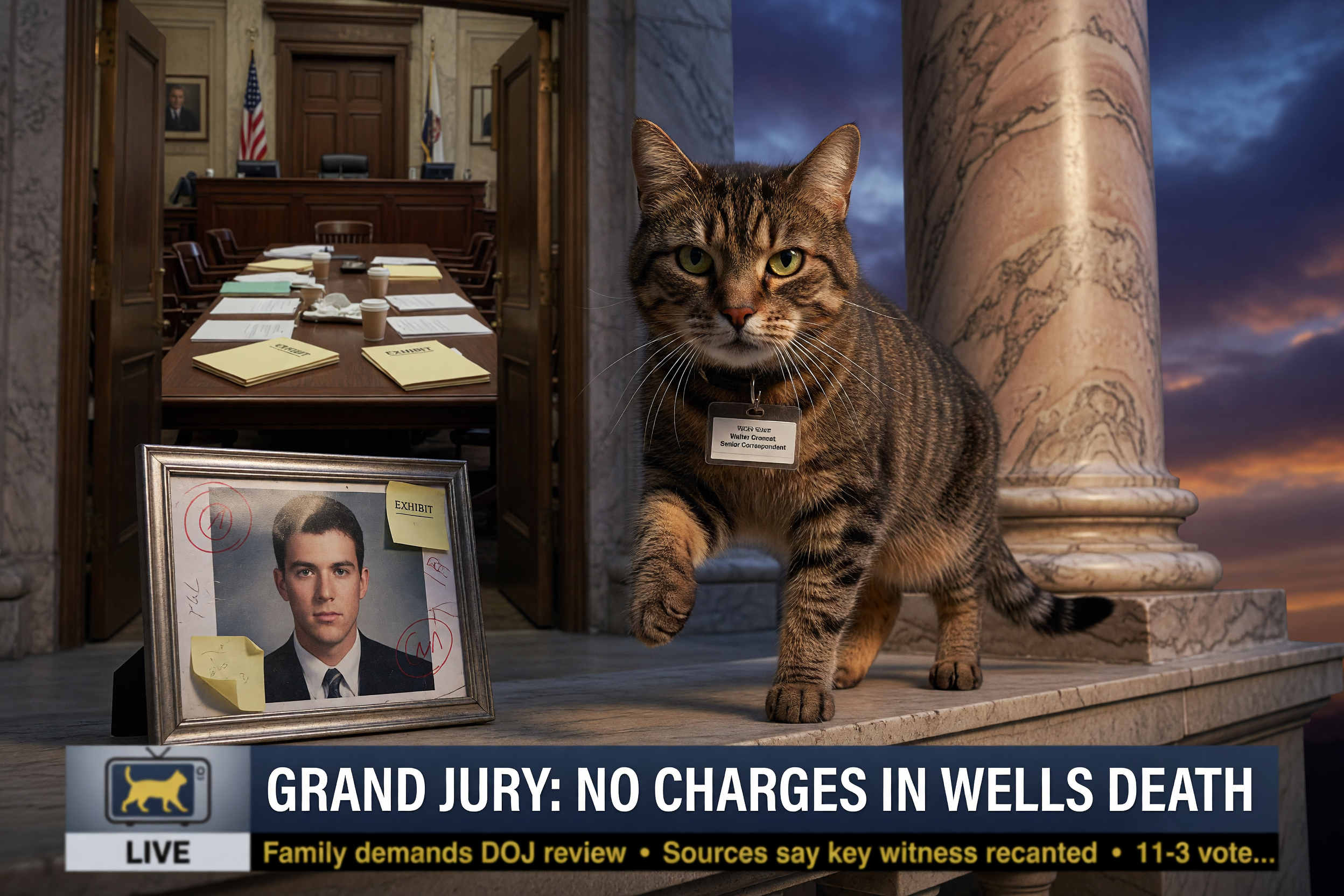
What Walter Read
Associated Press
Wire Service
Full Text
ABC News
Lean Left
Full Text
BBC News
International
Full Text
ABC News
Lean Left
Full Text
CBS News
Lean Left
Full Text
NBC News
Lean Left
Full Text
The Guardian
Left
Full Text
Meta-Analysis Brief
Suggested post type: REPORT — Seven articles from six outlets reported the same grand jury decision but with materially different emphases — from ABC's document-forward drowning conclusion to NBC's and the Guardian's family-forward focus on unexplained blunt force trauma — and no primary document was available to adjudicate the divergences, making this a coverage-comparison story rather than a straight REPORT.
Consensus Facts
- A Jackson County, Mississippi grand jury declined to bring criminal charges in the death of Nolan Wells, an 18-year-old Black man, with the decision announced late Monday, September 22, 2026.
- Wells disappeared on July 4, 2026 after a boating trip and party on Horn Island, a barrier island off the Mississippi Gulf Coast, and his body was found two days later (July 6) at the northwestern tip of the island.
- The grand jury report concluded that the position, condition, time of discovery, and location of Wells' body was 'consistent with drowning.'
- The grand jury found 'no credible evidence' that any persons who rode to or from Horn Island on July 4 engaged in criminal conduct related to Wells' death.
- The grand jury heard from 43 witnesses and reviewed physical and digital evidence including cellphone data, GPS data, forensic reports, videos, and images.
- Both the Mississippi medical examiner's office and an independent forensic pathologist hired by Wells' family found the cause and manner of death to be undetermined.
- There was bruising/blunt force injury to the back of Wells' head; the report said this was 'not a fatal injury' and how it occurred remains unexplained.
- District Attorney Angel Myers McIlrath oversaw the investigation and, in a roughly 15-minute social media video, said there was 'absolutely no evidence' the death was racially motivated and condemned 'false narratives.'
- McIlrath said lawyers for Wells' family had told her office their own private investigation found no evidence of a crime.
- Wells' friends, all of whom were white, said they left the island early and that Wells chose to stay behind; the family disputes that Wells would have stayed behind by choice.
- Civil rights attorney Ben Crump, representing the family, said the report 'leaves us with more questions than answers,' called for the investigation to remain open, and requested a U.S. Department of Justice investigation and release of the full medical examiner's autopsy report.
- The report noted there is no statute of limitations on homicide in Mississippi and that the matter could be re-presented if credible evidence of a non-accidental death emerges.
- The grand jury was described as a cross-section of 23 jurors (13 men, 10 women), with a racial breakdown of 12 white, 5 Black, 2 Hispanic, 2 Native American, 1 Asian, and 1 'other.'
- The grand jury disputed the public claim that Wells was the only Black person on Horn Island on July 4.
Disagreements
Number of grand jurors
Associated Press: Does not give a specific total juror count.
ABC News: States the grand jury consisted of 23 people (13 men, 10 women).
CBS News: States the grand jury consisted of 23 people.
The Guardian: States 23 grand jurors (13 men, 10 women).
BBC News: States 25 grand jurors heard from 43 witnesses.
Number of subpoenas issued
Associated Press: Reports the grand jury issued 132 subpoenas.
The Guardian: Reports 132 subpoenas.
ABC News, CBS News, BBC News, NBC News: Do not cite a subpoena count.
Name/spelling of the District Attorney
Most outlets (AP, ABC, BBC, CBS, Guardian): Angel Myers McIlrath.
NBC News: Refers to her in one instance as 'Angel Myers McArthur' (apparent error), while also using 'Myers McIlrath' elsewhere.
Whether Wells left his phone behind and its significance
ABC News (Article 4): Reports the family cast doubt on why a teen would stay without his phone and speculated messages were tampered with; phone was on the boat that took him and was later towed partway back after taking on water.
ABC News (Article 2) / CBS / Guardian: Frame it via the grand jury's finding that it is 'not unusual' for phones/items to travel back on boats other than their owners', debunking the suspicion.
BBC News: Notes the phone was retrieved later from friends on the mainland; frames grand jury's explanation as routine.
Characterization of the blunt force injury detail
The Guardian / NBC News: Emphasize the independent pathologist Dr. Roger Mitchell found 'recent unexplained blunt force injuries' to head and back and that it is unexplained; give this prominent weight to family's doubts.
ABC News (Article 2): Emphasizes the grand jury's framing that the bruise was 'not a fatal injury' and no evidence of fatal injury was found.
Associated Press / CBS / BBC: Mention the blunt force trauma mainly through the family's/Crump's objections.
Framing Analysis
Associated Press
Balanced wire treatment. Leads on the grand jury's 'no cause for charges' finding and immediately pairs it with the family's swift objection. Gives roughly equal space to McIlrath's defense of the probe (quoting her condemnation of 'false narratives') and to Crump/Sharpton invoking Mississippi's racial history (Emmett Till, Medgar Evers). Includes the friends' attorney's 'he could breathe for the first time' quote. Foregrounds the racial context and law enforcement's early 'no foul play' statement.
ABC News
Two distinct articles in the dossier. Article 2 (Sasha Pezenik) is the most document-forward: it drills into the grand jury report's specifics — toxicology limits from decomposition, no cocaine, fake-ID alcohol purchase, the witness who saw Wells 'slip awkwardly off the side of a boat,' and the 'not a fatal injury' framing of the head bruise. It leans on the report's own language and largely adopts the drowning-by-elimination conclusion. Article 4 is a republished AP wire, so it mirrors AP's balanced structure and adds detail on the family's phone-tampering suspicions and the report's closing praise of Wells' 'outstanding character.'
BBC News
International framing headlined explicitly around race ('death of black Mississippi teenager'). Leads with Crump's concern that Wells 'ended up dead after going out on a boat with three young white men' and conflicting witness statements. More compact; presents the DA's rejection of a racial motive and the drowning finding, but foregrounds the family's grievance and the racial dynamic. Contains a factual outlier: says 25 grand jurors (others say 23).
CBS News
Leads on the 'no indictment' outcome and reproduces the grand jury's sharpest language naming the three boats (Triton, Palm Beach, Tideline) and the 'public clamor and private malice' quote. Emphasizes the exoneration angle and McIlrath's 'exonerate those who have been falsely accused' framing. Balances with extensive prior 'CBS Mornings' quotes from Wells' father and Crump ('which is it?') highlighting the contradictions in the friends' accounts.
NBC News
Most family-forward framing, anchored to the Tuesday press conference. Headline centers the family's vow to 'never stop.' Leads with Crump's 'We'll never stop' rhetorical framing against the DA's alleged 'We'll never know.' Highlights the mother's complaint about receiving a text at 7:54 p.m. before the report's release as showing 'a lack of empathy,' and stresses unexplained blunt force trauma. Notes Crump had 'pointed the blame toward the friends' and alleged race was involved. Contains the DA surname error ('McArthur').
The Guardian
Left-leaning framing that gives the fullest airing to the family's forensic case while also reproducing the grand jury's strongest exonerating quotes. Emphasizes the 'unanimous' decision and procedural detail (132 subpoenas, Sept 14–18 sitting). Notably quotes Dr. Mitchell's finding that the record does not establish whether Wells entered the water on his own or was forced, or whether he was conscious — the most detailed presentation of the family's unresolved-death argument. Also reports the DA's assertion that the family itself knew the death was not racially motivated.
Primary Source Alignment
- No primary source (the actual grand jury report or the medical examiner's autopsy) was located in the dossier; all descriptions of the report are secondhand via outlet paraphrase and quoted excerpts.
- Outlets quote overlapping passages from the report ('consistent with drowning,' 'no credible evidence,' 'public clamor and private malice,' the future re-presentation clause), which lends cross-corroboration, but the full report text cannot be independently verified here.
- The report is described by NBC and the Guardian as only partially/redacted-copy posted to the DA's Facebook, and Crump is releasing the independent (Mitchell) autopsy while the state medical examiner's full autopsy has not been released — meaning key underlying documents remain unpublished and unverified against coverage.
Missing Context
- The full grand jury report and the state medical examiner's complete autopsy were not available in the dossier; coverage relies on selected quotes and paraphrase, so no outlet could be checked against the primary documents.
- No outlet reconciled the discrepancy between Dr. Mitchell's finding of blunt force injuries to the head AND back versus the grand jury's characterization of only a head bruise that was 'not a fatal injury.'
- No outlet explained the mechanics or timeline of how the boat 'taking on water' relates to the friends' departure and whether that was independently verified.
- The identity, statements, and any testimony of the girl Wells allegedly stayed to talk to are referenced only via conflicting secondhand accounts; no outlet clarified what she actually told investigators.
- There is a factual discrepancy on the grand jury size (BBC says 25; AP-derived, ABC, CBS, and Guardian say 23) that no outlet acknowledges or resolves.
- No outlet provided the status or any response from the U.S. Department of Justice regarding Crump's renewed request for a federal investigation.
- No outlet detailed what specific 'conflicting witness statements' Crump referenced beyond the stay-behind question, nor whether the grand jury addressed them.
- NBC News misidentifies the district attorney as 'Angel Myers McArthur' in one reference — a naming error a reader should be aware of.
Verification Gate Results
PASSED
All verification checks passed.
Draft Analysis
CLEAN
No factual issues found.
Story Selection
15 candidates detected, 13 passed triage
Selected: Grand jury declines to bring criminal charges in Nolan Wells death - BBC
Source: news_fetcher