Diplomacy or ‘diplotainment’? Key takeaways from the Trump-Xi summit in Washington - The Guardian
The Post
BBC and The Guardian report Xi Jinping visited the White House — his first Washington trip in over a decade — for a state dinner and closed-door talks with Trump. No breakthroughs confirmed.
reported by BBC News; also covered by news.google.com
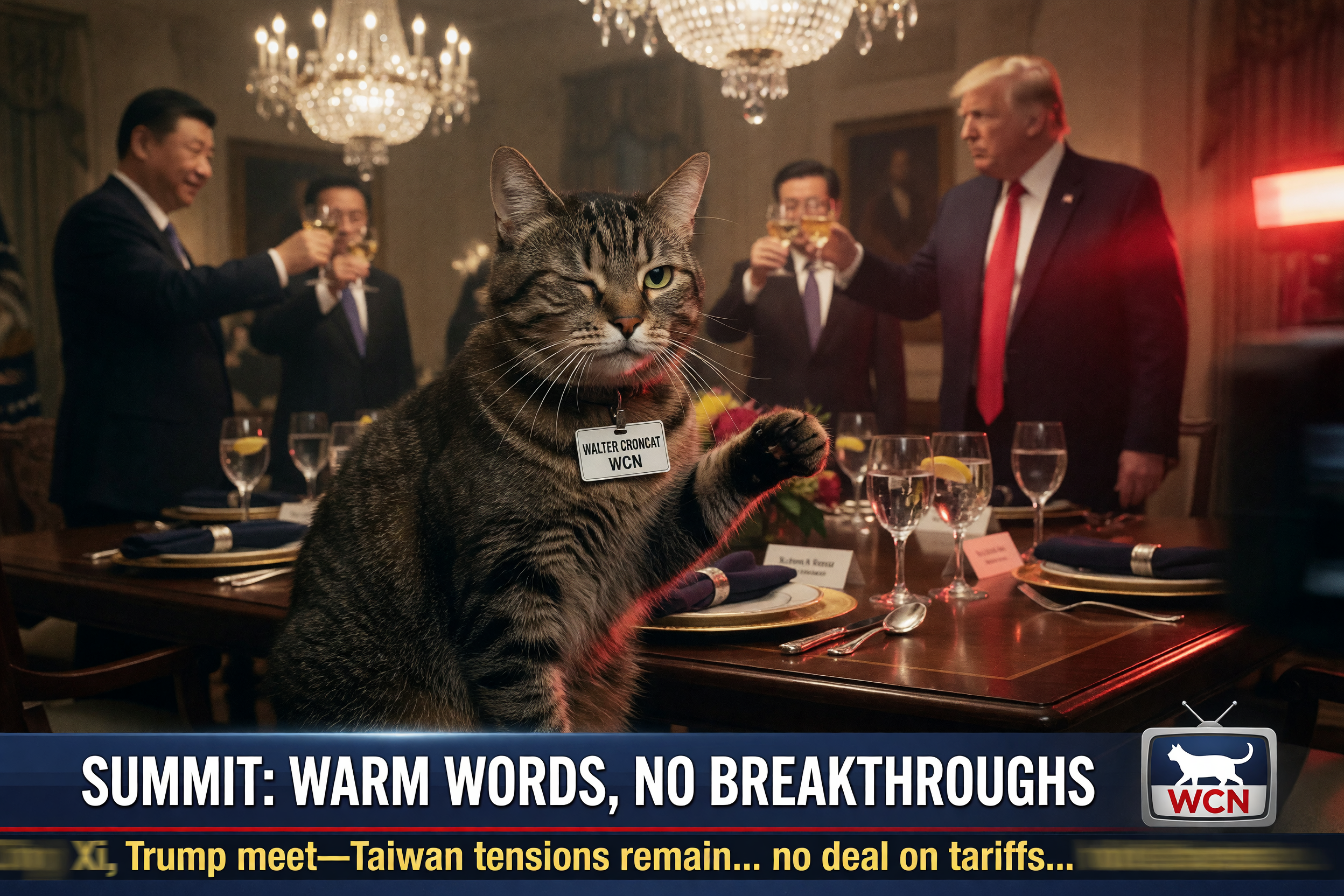
What Walter Read
BBC News
International
Full Text
news.google.com
Full Text
Meta-Analysis Brief
Suggested post type: REPORT — Two outlets covered the same state visit with materially different framings — the BBC leaning into ceremonial warmth and the Guardian foregrounding 'diplotainment' criticism and substance gaps — making the divergence in emphasis itself the story worth reporting.
Consensus Facts
- President Donald Trump hosted President Xi Jinping at the White House for a state visit, Xi's first visit to Washington in more than a decade.
- The state dinner featured a large contingent of US tech and business leaders, including Apple's Tim Cook, Nvidia's Jensen Huang, OpenAI's Sam Altman, Amazon's Jeff Bezos, Alphabet's Sundar Pichai, Elon Musk, and Mark Zuckerberg.
- Xi stated that both countries must ensure AI/its development remains under human control.
- Trump delayed/held in abeyance a roughly $14bn arms package for Taiwan, which he had described as a 'very good negotiating chip' after his May visit to China.
- Taiwan was a point of tension, with Xi urging Trump to take the 'correct position' / oppose 'Taiwan independence' on the self-governing island Beijing claims.
- The visit was heavy on ceremony and symbolism, with no clear public indication that the closed-door talks produced breakthroughs on key issues (AI, trade, Taiwan).
- First Lady Melania Trump planned the dinner menu, which included sesame-crusted sea bass, described as showcasing American ingredients with subtle Chinese influence.
Disagreements
Future Trump-Xi meetings
BBC News (international): Reports Xi confirmed the two would meet twice more by year's end — at the APEC leaders' meeting in Shenzhen, China in November and at the G20 in Florida in November.
news.google.com (The Guardian): Does not mention any planned future meetings between the two leaders.
Trade war truce
BBC News (international): Does not report a specific extension agreement; frames Trump's trade ambitions (lowering Chinese tariffs, rare earths, agricultural exports) as expected goals.
news.google.com (The Guardian): Reports both countries agreed to extend until 10 January an agreement pausing their trade war, but that experts saw few other tangible outcomes.
Scope of issues discussed / 'diplotainment' framing
BBC News (international): Notes 'little indication of progress' but frames the event largely through warm words and diplomatic niceties without adopting a critical label.
news.google.com (The Guardian): Foregrounds Senate Democrats' and former diplomat Danny Russel's criticism of 'pageantry over substance,' quoting Russel calling it 'diplotainment.'
Iran as a summit topic
BBC News (international): Does not mention Iran.
news.google.com (The Guardian): References a 'war with Iran' among the thorny issues, though provides no detail beyond listing it.
Media coverage of the event
BBC News (international): Does not address US television coverage.
news.google.com (The Guardian): Reports Trump and Xi's remarks were not carried live by any US TV networks, which refused footage in protest of the White House's ban of CNN, MS Now and Politico.
Framing Analysis
BBC News (international)
Leads with the 'warm words' at the state dinner and the personal diplomacy between the two leaders, using neutral-to-favorable descriptors ('lavish,' 'extravagant'). Emphasizes the guest list, menu details, and ceremonial gifts (the bald eagle sculpture). Acknowledges 'little indication of progress' but embeds that within a broadly diplomatic frame. Notably reports Anthropic's absence and confirms two future meetings. Buries any explicit criticism — no partisan voices quoted.
news.google.com (The Guardian)
Structured as a numbered 'key takeaways' explainer, leading directly with the critical 'Diplomacy or diplotainment?' framing. Foregrounds Senate Democrats' criticism and former diplomat Danny Russel's 'Pandas are cute, but what America needs are rare earths' quote. Emphasizes substance gaps, the stalled $14bn arms deal (including that at least 19 of 47 Senate Democrats signed a statement demanding delivery), the trade-war truce extension to 10 January, the unusual airport welcome, Chinese flags at the Oval Office, and the TV networks' protest boycott. More adversarial and politically contextualized than the BBC piece.
Primary Source Alignment
- No primary sources were located for this story. Claims such as the $14bn arms package, the 10 January trade truce extension, the Senate Democrats' signed statement, and Xi's readout via Xinhua could not be verified against underlying documents and rest solely on outlet reporting.
Missing Context
- Neither outlet provides the exact terms or scope of the trade-war pause being extended to 10 January, nor when the original agreement was struck.
- The Guardian references a 'war with Iran' as a summit topic but provides no context on the conflict, its status, or the US/China roles in it; the BBC omits Iran entirely.
- No outlet clarifies whether the closed-door meeting produced any commitments on rare earth minerals or US agricultural exports — items the BBC lists as Trump's goals but neither confirms as outcomes.
- The White House had not publicly commented on Xi's Taiwan remarks at the time of reporting; no US readout of the meeting is provided by either outlet.
- Anthropic's absence from the dinner is noted by the BBC but unresolved (the BBC says it asked whether Anthropic was invited or declined); no answer is reported.
- No primary sources (the Senate Democrats' statement, the Xinhua readout, or any official White House summary) were included in the dossier, so key attributed claims rest on single-outlet secondhand reporting.
- The BBC reports two additional planned meetings (APEC in Shenzhen and G20 in Florida) that the Guardian does not corroborate, leaving that schedule single-sourced.
Verification Gate Results
PASSED
All verification checks passed.
Draft Analysis
CLEAN
No factual issues found.
Story Selection
15 candidates detected, 13 passed triage
Selected: Diplomacy or ‘diplotainment’? Key takeaways from the Trump-Xi summit in Washington - The Guardian
Source: news_fetcher