‘Better deal’: What’s behind Trump’s rejection of Iran’s truce offer? - Al Jazeera
The Post
Trump said Saturday he rejected Iran's seven-day Hormuz roadmap — which included releasing $12bn in frozen assets. Iran's FM Araghchi told Al Jazeera no rejection came through official channels. NBC News confirms the standoff.
And that's the mews.
And that's the mews.
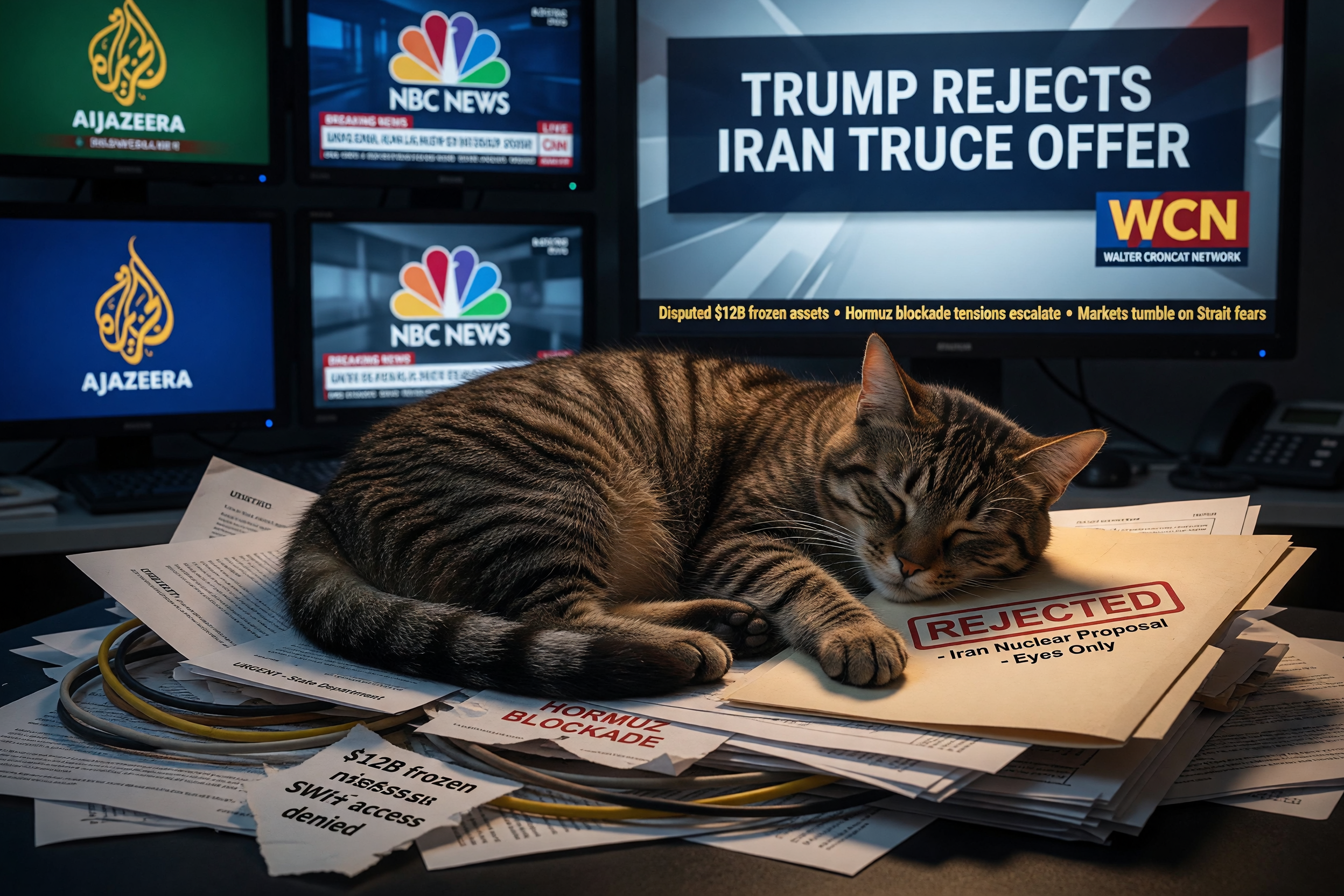
What Walter Read
Al Jazeera English
International
Full Text
Al Jazeera English
International
Full Text
NBC News
Lean Left
Full Text
Al Jazeera English
International
Full Text
Al Jazeera English
International
Full Text
Al Jazeera English
International
Full Text
Meta-Analysis Brief
Suggested post type: REPORT — Multiple articles cover the same event (Trump's rejection of Iran's Hormuz proposal) with materially different framing — NBC centers Trump's rhetoric and US polling while Al Jazeera centers Iranian conditions, US-Israel responsibility, and skepticism of US oil-transit claims — and key claims (the 'rejection' itself, post-midterm bombing, oil volumes) rest on unnamed sources that diverge, making the coverage divergence itself the story.
Consensus Facts
- US President Donald Trump publicly said on Saturday (Sept. 26, 2026) that he rejected Iran's proposal to reopen the Strait of Hormuz.
- Trump argued Iran wants a deal 'because they are losing so badly' and framed the offer as evidence of Iranian weakness.
- Iran's Foreign Minister Abbas Araghchi said no rejection had been conveyed through official channels/mediators, noting Trump makes 'contradictory' statements, and that Iran would await the mediators' definitive response before deciding.
- Iran's proposal was a seven-day roadmap: within roughly four to five days the US would lift its naval blockade on Iranian ports, waive/lift Iranian oil sanctions, release frozen Iranian assets, and observe a regional ceasefire (including Lebanon and Yemen); the Strait of Hormuz would then reopen and final-deal negotiations would begin around day seven.
- The new proposal closely mirrors the June memorandum of understanding (MoU) between the US and Iran, which collapsed within days/the following month amid renewed strikes over shipping routes.
- Qatar has been acting as a mediator, passing messages between the two sides on the sidelines of the UN General Assembly in New York.
- The US and Israel launched their war on Iran on February 28, 2026, after which Iran effectively closed/blocked the Strait of Hormuz, through which roughly 20% (one-fifth) of the world's oil flowed before the conflict.
- A US official told Al Jazeera that Washington is in no hurry to reach an agreement, saying the US is in a strong position with control of the Strait of Hormuz.
- The US recently imposed aviation/secondary sanctions targeting companies doing business with Iranian airlines, prompting flight cancellations affecting neighboring countries; Iraq is seeking exemptions for humanitarian flights.
- Trump posted an image on Truth Social labeling the waterway the 'Trump Strait.'
- Iranian President Masoud Pezeshkian said Tehran no longer trusts talks with Washington and that the Hormuz issue should be resolved through negotiation rather than force.
- The proposal called for the US to release an estimated $12bn in frozen Iranian assets.
Disagreements
Whether a formal rejection has occurred
NBC News: Reports Trump said he rejected the deal, while Araghchi says no rejection came through official channels — foregrounds this contradiction in the subheadline.
Al Jazeera (Trump rejects seven-day roadmap): Frames Trump as having rejected the plan while Araghchi 'ignores Trump, waits for mediators' response.'
Al Jazeera (Trump 'rejects'...What's next?): Puts 'rejects' in scare quotes and notes the US government has not publicly responded, attributing the rejection only to unnamed US officials via the Wall Street Journal.
Volume of oil transiting the Strait of Hormuz
Al Jazeera (Strait of Hormuz tensions): US Energy Secretary Chris Wright told Fox News the 'running average' of crude in transit was nearly 13 million barrels per day; US Central Command claimed forces helped move over one billion barrels out of the Gulf over roughly two months.
NBC News: A US official said nearly 40 million barrels of oil transited the strait over the last 48 hours.
Iran (via Al Jazeera): Tehran claims the US is providing false information about Strait of Hormuz traffic to project control over the waterway.
Iranian approval/disapproval polling on the war
Al Jazeera (What's behind Trump's rejection): Cites a late-August Reuters/Ipsos poll showing 63% of Americans opposed the war and 31% supported it.
NBC News: Cites its own NBC News Decision Desk Poll showing 31% approved of Trump's handling of the Iran war and 69% disapproved.
Whether the strait is open and who controls it
Al Jazeera (Strait of Hormuz tensions): IRGC maintains the strait is closed to ships not coordinating with Iran; Washington insists its warships are successfully guiding tankers out via a different route; both sides claim control.
NBC News: Notes Trump claims 'total control' and the 'greatest blockade ever,' while reporting Iran effectively blocked the strait.
Interpretation of Iran's motive for the offer
Al Jazeera (What's behind Trump's rejection): Experts (Krieg, Weitz) frame it as evidence Trump believes economic pressure is squeezing Iran; Trump sees weakness.
Al Jazeera (Trump rejects seven-day roadmap): Analyst Ross Harrison frames the proposal chiefly as a goodwill gesture aimed at Iran's home audience and the American public, with Iran anticipating rejection.
Al Jazeera (What's in Iran's seven-day plan): Analyst Urban Coningham frames it as a tactic to pressure Trump over fuel/gas prices ahead of the midterms.
Post-election intentions
Al Jazeera (Trump rejects seven-day roadmap / What's next): WSJ, via unnamed US officials, reports Trump told aides he expects a renewed bombing campaign on Iran after the November midterms.
NBC News: Reports Trump said he believes a deal will be reached right after the election, and that Iran is 'waiting to see how I do in the midterm election.'
Framing Analysis
Al Jazeera English
Al Jazeera dominates the dossier with five articles across formats (analysis, economy, news, explainers). It consistently uses the framing 'US-Israel war on Iran' as its section label, foregrounding US-Israeli responsibility for the conflict. Its analysis piece ('What's behind Trump's rejection') leans on expert commentary (Krieg, Weitz) to frame Trump's move as a calculated leverage bet with midterm political risk. The economy piece ('Strait of Hormuz tensions linger') leads with reported explosions in the waterway hours after the rejection and gives extensive space to Iranian military defiance (Shekarchi's 'it will get slapped' warning), while presenting US oil-transit claims skeptically alongside Iran's counterclaim that the US is lying. The explainers systematically center Iranian conditions and the June MoU as the legitimate baseline, and repeatedly note Israel's occupation of southern Lebanon. Across all five, Iran's perspective (Araghchi, Pezeshkian, IRGC) is quoted at length and Trump's statements are often placed in a 'contradictory' or 'no alternative offered' context.
NBC News
Leads squarely on Trump's own words, quoting his 'losing so badly' and 'they're dying' remarks at length and giving prominence to his 'greatest blockade ever in military history' boast and the 'Trump Strait' Truth Social post. It foregrounds the contradiction in its subheadline — that Araghchi says no rejection came through official channels. It attributes the initial rejection scoop to the Wall Street Journal. NBC emphasizes the domestic US political dimension (its own Decision Desk poll showing 69% disapproval, the midterm timing, Pezeshkian's comment about wanting a deal before the elections). Compared to Al Jazeera, NBC is more centered on Washington's framing and Trump's rhetoric, and includes the US official's specific oil-transit figure (40 million barrels in 48 hours) without the skeptical juxtaposition Al Jazeera applies.
Primary Source Alignment
- No primary source documents (the text of Iran's seven-day proposal, the June 17 Islamabad MoU, the Reuters/Ipsos or NBC poll crosstabs, or CENTCOM's Sept. 19 operational update) were located for this story. All characterizations of the proposal's terms rest on secondhand reporting of Araghchi's briefings and unnamed US officials via the Wall Street Journal and New York Times.
- Because the underlying MoU and proposal texts are unavailable, the recurring claim that the new plan 'mirrors' the June MoU cannot be independently verified against the documents — it is attributed to Araghchi and analysts, not confirmed against source text.
Missing Context
- This dossier is heavily single-outlet: five of six articles are from Al Jazeera and only one (NBC News) provides an independent outlet's body text. Many 'consensus' items are corroborated by Al Jazeera + NBC, but the framing is disproportionately Al Jazeera's. No right-leaning or center outlet body text is present.
- The two US oil-transit figures cited (nearly 13 million barrels/day per Energy Secretary Wright; nearly 40 million barrels in 48 hours per an unnamed US official; over 1 billion barrels over two months per CENTCOM) are not reconciled by any outlet, and no independent verification of shipping volumes is provided.
- The core 'renewed bombing after the midterms' claim rests entirely on unnamed US officials cited by the Wall Street Journal (secondhand in this dossier), which directly conflicts with Trump's on-record statement that a deal will come after the elections — neither claim is independently sourced.
- No outlet reports casualty figures or the human cost of the seven-month war beyond a single killed sailor on an Indian cargo ship; the broader humanitarian and economic toll on Iran and the Gulf is only alluded to.
- The dossier does not include any Israeli government statement or perspective despite the conflict being framed as a 'US-Israel war on Iran' and Israel's occupation of southern Lebanon being referenced.
- No verifiable data is provided on actual global oil/energy price movements resulting from the strait's disruption, despite this being central to the midterm-pressure framing.
- The exact, verbatim conditions of Iran's proposal differ slightly in emphasis across pieces (e.g., the Oman-agreed maritime transit route, the $12bn figure, the Lebanon/Yemen ceasefire scope), and no single authoritative text resolves the precise terms.
- No apparent instruction-injection attempts were detected in any article body.
Verification Gate Results
PASSED
All verification checks passed.
Draft Analysis
CLEAN
No factual issues found.
Story Selection
15 candidates detected, 11 passed triage
Selected: ‘Better deal’: What’s behind Trump’s rejection of Iran’s truce offer? - Al Jazeera
Source: news_fetcher