Supreme Court lets quick deportations to third countries resume for now while it weighs Trump policy - AP News
The Post
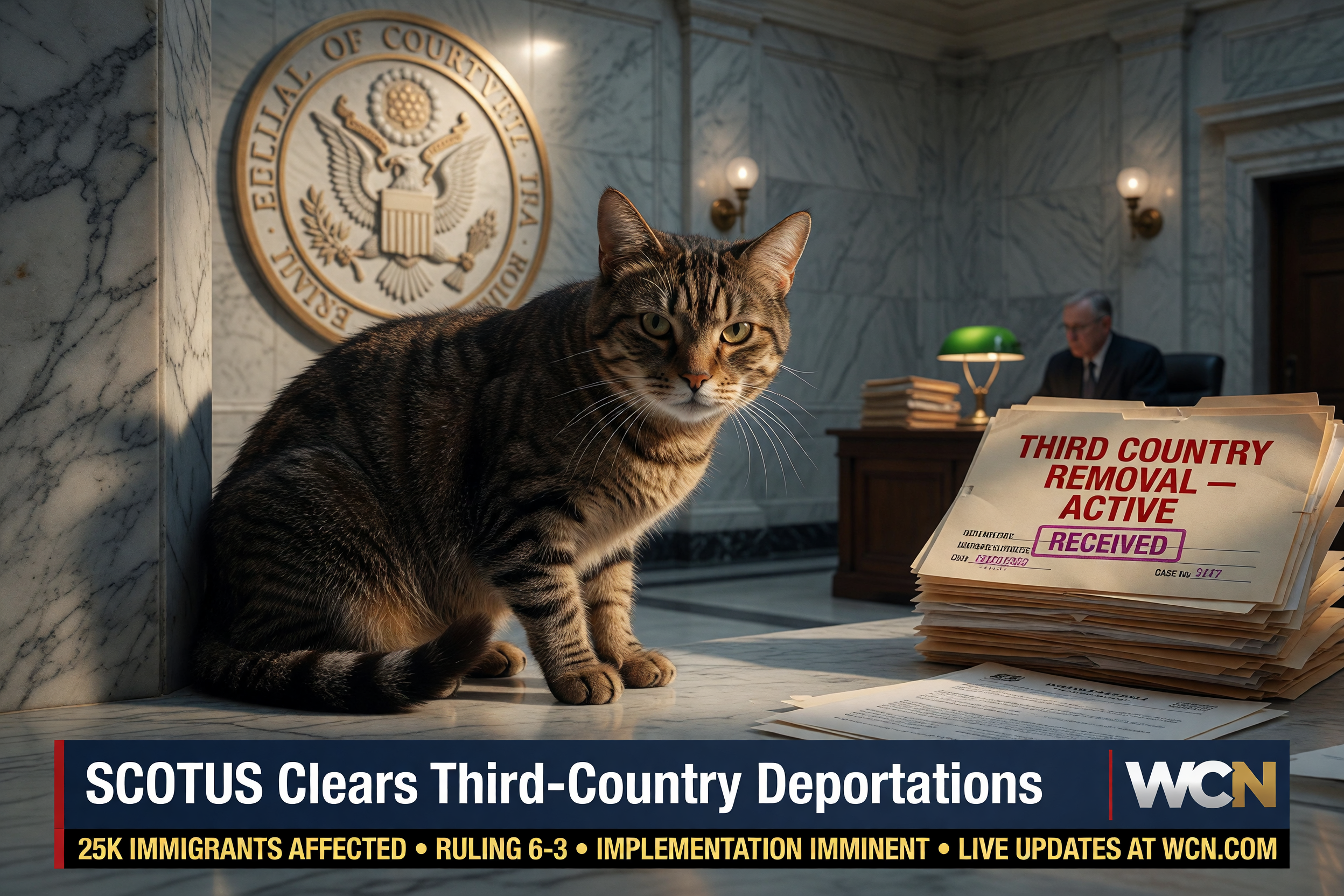
SCOTUS cleared third-country deportations to resume Tuesday, staying a lower-court ruling. Axios and CBS News confirm three liberal justices dissented. Roughly 25,000 immigrants have been subject to the policy. Oral arguments set for December 2026.
And that's the mews.
And that's the mews.
What Walter Read
The Washington Post
Lean Left
Headline Only
Al Jazeera English
International
Full Text
Axios
Beat Reporter
Full Text
NBC News
Lean Left
Full Text
CBS News
Lean Left
Full Text
Politico
Beat Reporter
Full Text
Axios
Beat Reporter
Full Text
Meta-Analysis Brief
Suggested post type: REPORT — Six full-text outlets reported the same Supreme Court order but with materially different framings — Al Jazeera and CBS lead on human-rights harms, NBC and Axios on procedure, and Axios separately embeds it in a broader shadow-docket critique — while the underlying deportation-count figures diverge and no primary source was available to adjudicate. This is a coverage-comparison story, not a straight REPORT.
Consensus Facts
- On Tuesday, September 29, 2026, the U.S. Supreme Court granted the Trump administration's emergency request to resume deportations of immigrants to 'third countries' where they have no ties, staying a lower court ruling.
- The Supreme Court's three liberal justices — Sonia Sotomayor, Elena Kagan and Ketanji Brown Jackson — indicated they would have denied the administration's request.
- The order was unsigned, as is typical for emergency (shadow) docket petitions, and the court said it will hear oral arguments in the case in December 2026.
- The lower court ruling being stayed came from U.S. District Judge Brian Murphy in Boston/Massachusetts, who held that migrants must be given a meaningful opportunity to raise safety concerns (torture/persecution) before removal, and much of it was upheld by a federal appeals court.
- The Supreme Court previously (in 2025) allowed third-country deportations to proceed after an earlier Murphy order, including clearing the way for deportations to South Sudan.
- The Trump administration argued the lower court decisions impeded efficient removal operations, including citing cancelled deportation flights.
- James Percival, general counsel of the Department of Homeland Security, cheered the decision, calling it a win and urging people to self-deport with an offer of '$3,000 and a flight home.'
- Roughly 25,000 people have been subject to third-country deportations, according to figures cited by the administration and rights groups.
- Deportees have been sent to countries including South Sudan, and destinations cited include Eswatini, Rwanda, the Central African Republic, El Salvador and Liberia.
- The Trump administration's March 2025 policy allows officials to send deportees to third countries based on blanket assurances those countries will not persecute or torture them.
Disagreements
Number of people deported to third countries
Al Jazeera English: Estimates that more than 25,000 people have been subject to third-country deportations (citing Refugees International and Human Rights First).
Axios: DHS General Counsel James Percival said about 25,000 undocumented immigrants had been deported to third nations.
NBC News: About 15,000 people were deported to third countries in 2025, per the Migration Policy Institute, with Mexico receiving the majority.
CBS News: The administration estimates the policy has led to deportations of 'thousands,' with 'thousands more' eligible.
Date/origin of the specific lower-court order being stayed
CBS News: A February order from a federal district judge, largely upheld by a federal appeals court earlier this month.
Axios: A February 2026 order from Judge Murphy, much of which was backed by a recent appeals court decision; notes a prior stay followed an April 2025 Murphy order.
Al Jazeera English: References Murphy's ruling generally without pinning a February date.
Number of flights/migrants affected by the cancellation
CBS News: DHS had to cancel a flight to three countries for 70 migrants, some with criminal records.
Axios: Cites Sauer stating the appeals court decision created substantial logistical problems including cancellation of flights, without a specific count.
Attribution note
Al Jazeera English: Al Jazeera bylines the story as 'Al Jazeera Staff and Reuters,' meaning its account partly relies on the Reuters wire rather than being fully independent.
Framing Analysis
The Washington Post
Headline-only in this dossier. Headline frames the outcome neutrally as the court allowing 'third country' deportations 'to resume for now,' emphasizing the temporary nature. No body text available to assess emphasis or omissions.
Al Jazeera English
Frames the story through a human-rights and international lens. Leads with the court allowing Trump to 'continue' the practice and quickly pivots to due-process concerns, UN human-rights experts urging a halt, the vulnerability of children/women/LGBT persons, and the record of receiving countries' abuses. Emphasizes the 35+ countries that signed agreements and Burundi's new deal. Buries the administration's efficiency/enforcement rationale, mentioning it only briefly.
Axios
Two distinct entries. Article 7 gives a tight procedural account, leading with the stay, the December argument date, the liberal dissent, and quoting Sotomayor's earlier 'matters of life and death' dissent. Emphasizes DHS's 25,000 figure and Sauer's logistical-harm argument. Article 3 zooms out to a systemic frame — Trump's record-setting 41 shadow-docket applications versus Biden (19), Obama (3) and Bush (5) — treating the deportation ruling as one data point in a critique of shadow-docket overuse, quoting the Brennan Center and Justices Jackson/Kagan, and balancing with White House and DOJ defenses.
NBC News
Leads with the court 'removing obstacles' and notes it is the second time the court rejected lower-court rulings requiring pre-removal objections. Balances the DHS celebratory quote with a plaintiffs' lawyer warning of immediate risk to lives. Distinctively cites the Migration Policy Institute figure of ~15,000 deported in 2025 (Mexico majority) — a notably lower and differently-scoped number than the 25,000 cited elsewhere. Notes MAGA-world criticism of the earlier blocked ruling. Body appears truncated.
CBS News
Frames as reviving the policy 'for now' and leans into on-the-ground reporting: its own interviews with deportees in Liberia who learned of their African destination hours before or mid-flight. Emphasizes the secrecy of the country agreements, the dangerous destinations, and the March 2025 blanket-assurance mechanism. Includes the DHS quote and the specific cancelled-flight (70 migrants) detail, plus a projected mid-2027 ruling timeline. Ends by linking to a Free Press piece framing media as having 'freaked out' — an outbound editorial pointer.
Politico
Off-core: this article is about a separate emergency appeal (transgender inmate care), not the third-country deportation ruling itself. It documents the Bureau of Prisons policy, the executive order, and the ACLU/Transgender Law Center challenge — relevant only as context for the shadow-docket pattern Axios describes, not for the deportation story.
Primary Source Alignment
- No primary source (Supreme Court order, Solicitor General application, or Murphy's ruling) was included in the dossier, so no direct document-to-coverage comparison is possible.
- Outlets characterize the Supreme Court order consistently: unsigned, three liberals would deny, December argument date, and specified legal questions (federal law, Due Process Clause, regulations per CBS). These characterizations should be verified against the actual order, which was not provided.
Missing Context
- No primary source was located — the actual Supreme Court order, the Solicitor General's application, and Judge Murphy's ruling are all absent, so all procedural characterizations rest on secondhand reporting.
- The deportation-total figures are not reconciled: NBC's ~15,000-in-2025 (Migration Policy Institute) is scoped differently from the ~25,000 cumulative figure the administration and rights groups cite, and no outlet explains the discrepancy or overlapping timeframes.
- No outlet fully explains the legal standard the Supreme Court applied to grant the stay (e.g., likelihood of success, irreparable harm), nor how the December argument relates to the underlying merits.
- Little detail on what recourse, if any, remains for individuals already in the deportation pipeline while the stay is in effect.
- The 'blanket assurances' mechanism (CBS) is described but no outlet examines how those assurances are verified or enforced against countries with documented human-rights abuses.
- The names and party affiliations of the majority justices are not stated by any outlet (only the three dissenters are named); the exact vote breakdown beyond '3 liberals would deny' is unspecified.
- Axios Article 3 and Politico Article 6 concern a separate transgender-inmate-care shadow-docket application, not the deportation ruling; a reader should note the deportation story is being contextualized within, but is distinct from, that filing.
Verification Gate Results
PASSED
All verification checks passed.
Draft Analysis
CLEAN
No factual issues found.
Story Selection
15 candidates detected, 11 passed triage
Selected: Supreme Court lets quick deportations to third countries resume for now while it weighs Trump policy - AP News
Source: news_fetcher