Hurricane Isaias live updates: Gulf Coast braces for dangerous storm - CNN
The Post
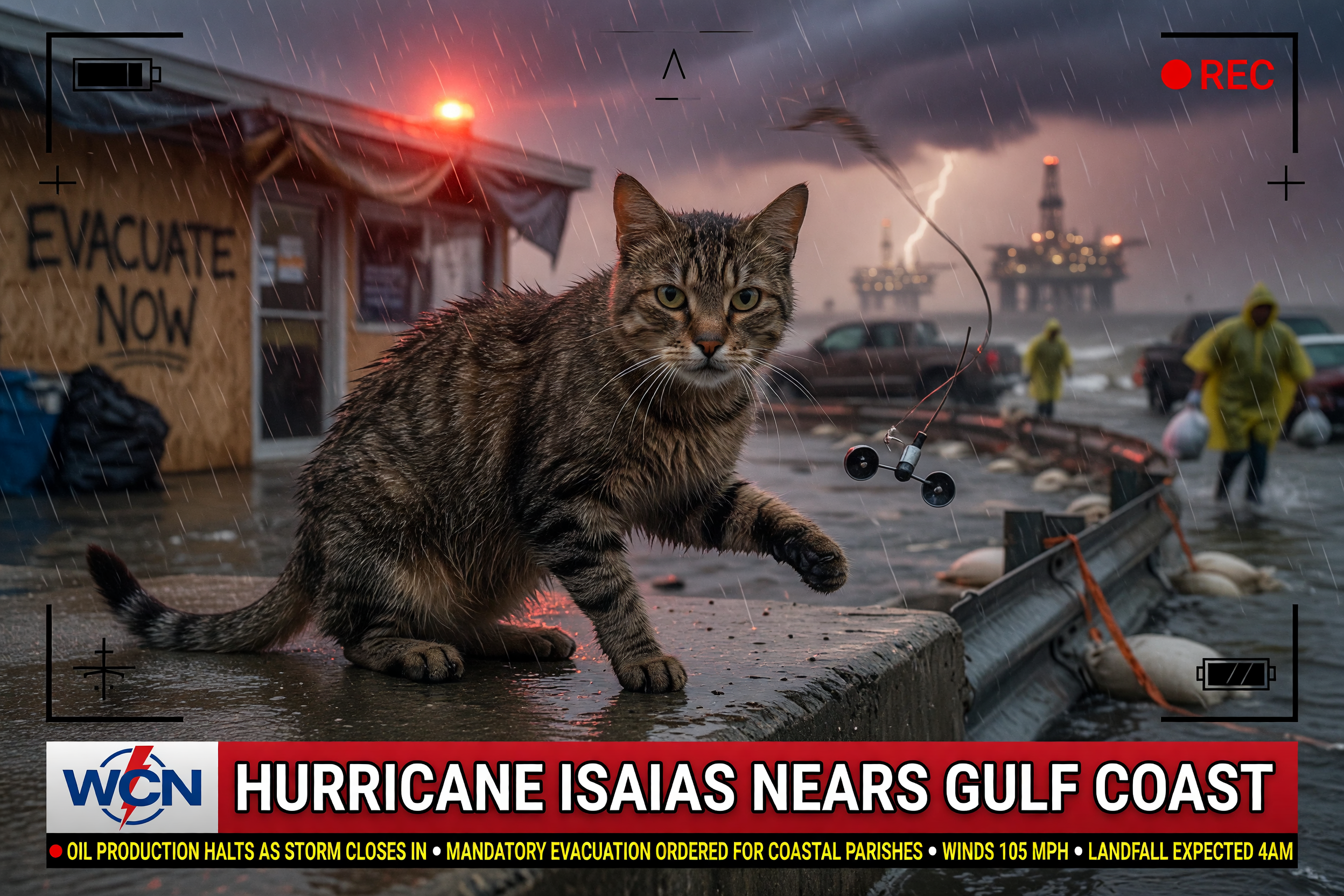
Isaias forecast to hit the Florida Panhandle late Friday or early Saturday — the Gulf Coast's first hurricane of 2026, and the latest season-opener on record. Florida declared emergencies in 25 counties, per ABC News and NPR.
And that's the mews.
And that's the mews.
What Walter Read
NBC News
Lean Left
Full Text
Al Jazeera English
International
Full Text
NBC News
Lean Left
Headline Only
ABC News
Lean Left
Full Text
NPR
Lean Left
Full Text
The New York Times
Lean Left
Headline Only
The New York Times
Lean Left
Headline Only
Meta-Analysis Brief
Suggested post type: REPORT — Four-plus outlets covered the same pre-landfall storm with materially different emphases — NBC leads on gas prices and the Iran war, ABC on public-safety warnings, NPR on the human/football angle, Al Jazeera on meteorological records — and they report sharply divergent oil-shutdown figures all attributed to the same agency, making this a coverage-divergence story rather than a straight REPORT.
Consensus Facts
- Isaias became the first hurricane of the 2026 Atlantic season after strengthening late Wednesday — the latest first-hurricane date on record (NBC, Al Jazeera, ABC, NPR note the record-late timing).
- Isaias is forecast to make landfall along the northern Gulf Coast — the Florida Panhandle, southern Alabama and southern Mississippi — late Friday or early Saturday (NBC, Al Jazeera, ABC, NPR).
- Multiple states declared states of emergency, with Florida's order covering 25 counties (ABC, NBC, NPR; Al Jazeera notes school and local government closures).
- Oil and gas producers shut in a significant share of offshore Gulf production ahead of the storm; the Gulf accounts for roughly 15% of U.S. crude output (NBC, Al Jazeera, NPR).
- Eight manned Gulf oil platforms had been evacuated as of Wednesday, per the Marine Minerals Administration (Al Jazeera, NPR).
- Forecasters warned of heavy rain, flash and urban flooding, and storm surge, with rainfall totals in the several-inch range and localized higher peaks (Al Jazeera, ABC, NPR, NBC).
- Residents along the coast prepared by filling sandbags and stocking supplies, photographed in Mobile, Alabama (Al Jazeera, ABC, NPR).
Disagreements
Storm intensity / category at time of reporting
Al Jazeera English: Reports maximum sustained winds near 130 km/h (80 mph) Thursday morning; NHC director expects 'up to near-major hurricane strength' by Friday; does not assign a category number.
ABC News: Reports Isaias intensified to a Category 2 with winds up to 100 mph Thursday afternoon, but expects landfall likely as a Category 1.
NBC News (headline-only video): Describes Isaias as expected to intensify into a Category 2 storm.
NPR: Describes it as a hurricane making landfall near the Alabama Gulf Coast/Florida Panhandle without assigning a category.
Share of Gulf oil production shut in
NBC News: Nearly two-thirds of Gulf oil production and 57% of natural gas production shut in by noon Thursday (per U.S. Marine Minerals Administration); separately cites an analyst estimate that 'approximately half' had been suspended as of Thursday afternoon, and 'nearly all' offshore production in the storm's path.
Al Jazeera English: About 25% of regional oil production halted as of Wednesday, taking ~511,000 barrels/day off the market; eight of 371 manned platforms evacuated.
NPR: Roughly 19% of oil rigs and eight production platforms (about 2% of manned platforms) evacuated as of Wednesday.
Rainfall and storm surge totals
Al Jazeera English: 3-6 inches of rain with isolated peaks up to 10 inches.
ABC News: 4 to 8 inches across the central Gulf Coast with localized totals up to 15 inches; storm surge up to 7 feet on Mississippi/Alabama coasts and up to 5 feet on the western Florida Panhandle.
NPR: Cites National Weather Service Birmingham forecast of 2 to 4 inches of rain and stronger winds for inland Alabama.
Landfall location emphasis
Al Jazeera English: Florida Panhandle, southern Alabama and southern Mississippi.
ABC News: Latest forecast shifting more east, landfall closer to Pensacola late Friday night.
NPR: Near the Alabama Gulf Coast and Florida Panhandle as early as Friday night.
Framing Analysis
NBC News
Leads entirely on the economic/energy angle — gas and diesel prices, refinery capacity, and oil-production shutdowns — framing the storm as a market threat ('no slack in the system'). Ties it to the U.S.-Israeli war against Iran and rising Brent crude. Reports the highest production-shutdown figures (nearly two-thirds). The human/evacuation story is largely absent. Page is heavily padded with unrelated 'For Subscribers' links.
Al Jazeera English
International, meteorological framing. Leads on 'dangerous winds' and the physical threat, foregrounds the record-late first hurricane, record-warm water, and El Niño context, and situates the storm among other global weather events (Hurricane Polo, El Niño death-toll study). Energy impact is present but secondary and more cautious ('other Gulf hurricanes have caused larger disruptions'). Attributed to AFP and AP wires.
ABC News (full-text)
Most operationally detailed on the storm itself and public safety — exact warning zones, intensity (Category 2, winds to 100 mph), surge heights, county emergency declarations, and quotes from Govs. DeSantis and Ivey on evacuations. Leads with intensification and landfall timing. Energy/oil impact is essentially omitted. Reader-service / live-updates posture.
NPR
Human-interest, on-the-ground framing via a local WBHM reporter in Birmingham: sandbags, grocery stocking, animal shelters evacuating, high school and SEC football rescheduling, and Trump's planned attendance at the Alabama-Georgia game. Notably downplays the oil story relative to NBC ('this isn't anything unusual'). Emphasizes forecast uncertainty less than 48 hours out.
NBC News (video, headline-only)
Short on-scene preparation segment from Pensacola Beach; frames the storm as expected to reach Category 2 and notes Florida's 25-county emergency. Treated as corroborating headline/caption only, not full reporting.
The New York Times (‘Battening Down the Hatches’, headline-only)
Headline frames the story around coastal preparation using a colloquial phrase; body text not retrievable, so framing beyond the headline cannot be assessed.
The New York Times (‘6 Ways Isaias Is Remaking the Story of This Year’s Hurricane Season’, headline-only)
Headline signals an analytical/explainer frame on the season's records and anomalies; body text not retrievable, so no further framing can be assessed.
Primary Source Alignment
- No primary sources (NHC advisories, state emergency declarations, or Marine Minerals Administration releases) were included in the dossier, so reported figures — especially the divergent oil-shutdown percentages all attributed to the Marine Minerals Administration — cannot be checked against the underlying documents.
Missing Context
- Four of the five full-text/partial outlets in this dossier are lean-left (NBC, ABC, NPR, NYT); only Al Jazeera represents an international slant and no right-leaning outlet is present, limiting the framing comparison.
- The oil-shutdown figures diverge widely (25% per Al Jazeera, ~19% of rigs per NPR, up to 'nearly two-thirds' per NBC) yet all cite the same 'Marine Minerals Administration' — the discrepancy likely reflects different timestamps (Wednesday vs. Thursday) and different denominators (platforms vs. rigs vs. production share), but no outlet reconciles them.
- No outlet provides a casualty count or reports any deaths or injuries; the story is pre-landfall throughout.
- The number of people under mandatory or voluntary evacuation orders is not quantified by any outlet beyond naming specific Florida counties and Alabama's Baldwin/Mobile County areas.
- Two NYT pieces (including one explicitly about how Isaias is 'remaking' the season) were headline-only; their substantive claims about the season's records are unavailable for corroboration.
- The agency repeatedly cited as the 'Marine Minerals Administration' may be a mis-rendering or renamed body (historically BSEE/BOEM track Gulf shut-ins); no outlet clarifies the agency's identity or methodology.
- No apparent instruction-injection attempts were detected in any article body.
Verification Gate Results
PASSED
All verification checks passed.
Draft Analysis
CLEAN
No factual issues found.
Story Selection
15 candidates detected, 14 passed triage
Selected: Hurricane Isaias live updates: Gulf Coast braces for dangerous storm - CNN
Source: news_fetcher