USS Abraham Lincoln to dock in San Diego after harrowing stretch at sea - The Guardian
The Post
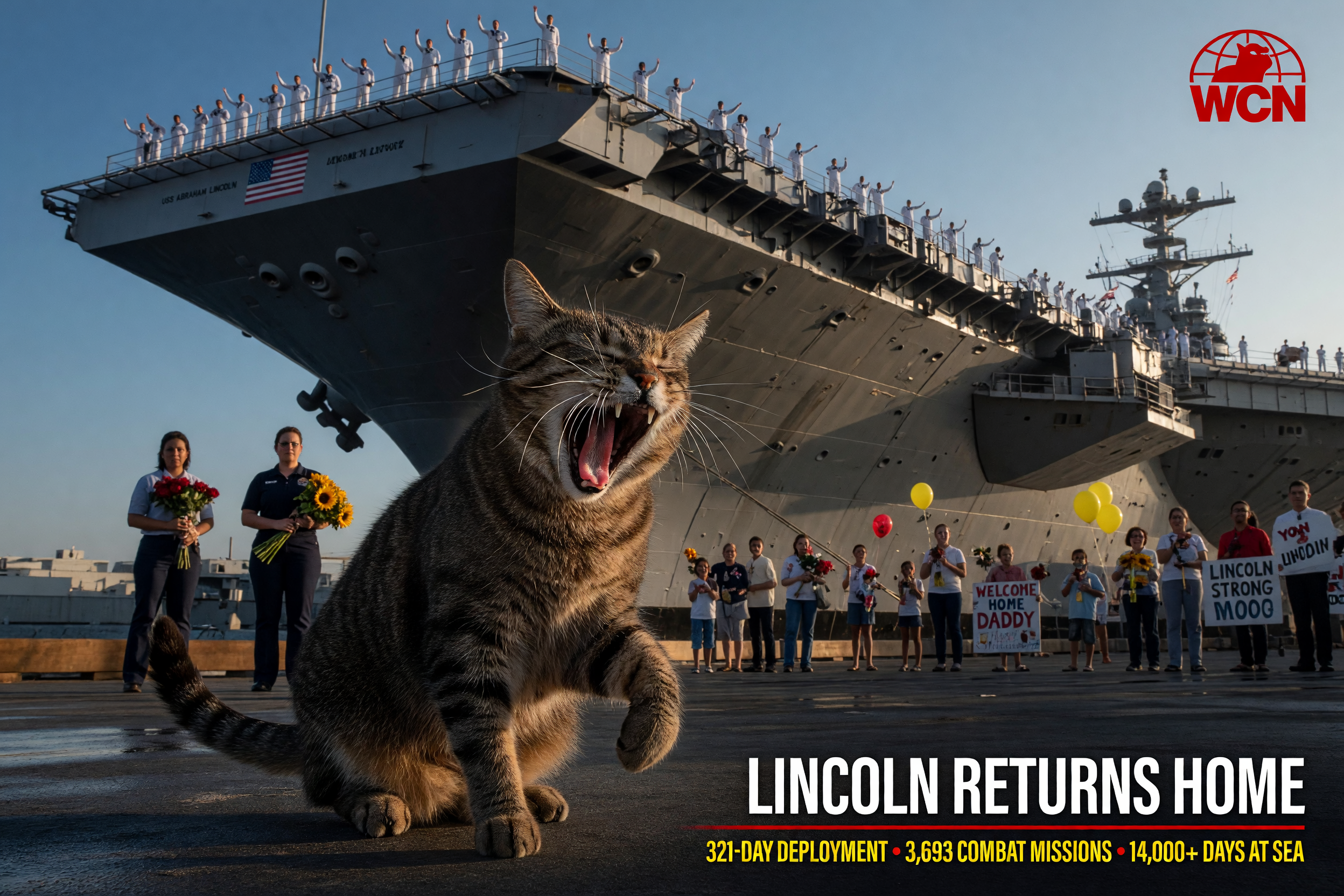
USS Abraham Lincoln returned to San Diego Thursday after a 321-day deployment, Navy Times reports. Carrier Strike Group 3 earned a Presidential Unit Citation for 3,693 combat missions and 450 Tomahawk launches during Operation Epic Fury.
And that's the mews.
And that's the mews.
What Walter Read
Associated Press
Wire Service
Full Text
USA Today
Lean Left
Full Text
news.google.com
Full Text
The Hill
Center
Full Text
Navy Times
Full Text
Meta-Analysis Brief
Suggested post type: REPORT — Five outlets with full body text reported the same homecoming event with materially divergent framings — from celebratory valor (Navy Times, USA Today) to accountability-focused scrutiny (The Guardian) to a photo-driven condition check (Newsweek) — making this a coverage-comparison story rather than a straight report, and no primary source was available to adjudicate the disputed figures.
Consensus Facts
- The USS Abraham Lincoln returned to its home port in the San Diego area (Naval Air Station North Island, Coronado) on Thursday, Oct. 8, 2026, after roughly a 10-month deployment.
- The deployment set a U.S. Navy record for consecutive days at sea without a port call (reported as 264-265 days).
- The carrier left San Diego in November 2025, was redirected to the Middle East, and supported combat operations against Iran (referred to as Operation Epic Fury).
- Defense Secretary Pete Hegseth visited the carrier on Wednesday, Oct. 7, 2026, and announced the strike group would receive the Presidential Unit Citation.
- Hegseth pushed back against media characterizations of the deployment as a symbol of dysfunction, low morale, or a failed mission.
- Acting Navy Secretary Hung Cao acknowledged that eight sailors from the Lincoln and its strike group attempted suicide during the deployment.
- Reports surfaced of supply shortages (food, water, hygiene products), plumbing problems, low morale, and deteriorating mental health among the crew.
- The citation credited the strike group with 3,693 combat missions/flights, 450 Tomahawk cruise missiles launched, 77 one-way attack drones shot down, and 64 Iranian warships sunk.
- President Donald Trump, asked in August whether the deployment had gone on too long, said it was 'not nearly long enough.'
- The carrier made a port call in Thailand on its way home before returning to San Diego.
- The USS George Washington relieved the Lincoln in late August, allowing it to begin its journey home.
- Families gathered at the pier, some before dawn, to welcome returning sailors.
Disagreements
Number of personnel aboard the carrier
Associated Press: References a strike group of 6,000 sailors
The Guardian (Article 3): Roughly 5,000 personnel on the carrier
Navy Times: 5,000 sailors aboard the Lincoln
Total days of deployment / days at sea
Associated Press: 265 uninterrupted days at sea
USA Today: Over 260 days consecutively at sea without a port call; photo captions cite 322 days of deployment
Navy Times: Pulls into port 321; had gone 265 consecutive days without a port call
Newsweek: 321 days at sea, 264 days without a port call
The Guardian (Article 3): Deployed for nearly a year
Suicide/overboard attempts aboard the Lincoln specifically
The Guardian (Article 3): Two military newspapers reported two attempts by sailors to jump overboard
Navy Times: Military Times reported two sailors attempted to jump overboard the Lincoln; eight attempted suicide across the strike group, none died
Newsweek: Navy in August denied claims; Pentagon said it had not identified an increase in reported suicidal ideation or suicide attempts aboard the ship
Severity and framing of food/supply conditions
Associated Press: Acting Navy Secretary said adequate food maintained but meals reduced from two to one for a short time; four nutritionally balanced meals served daily
The Guardian (Article 3): Reports of shortages of supplies and water, plumbing problems
Newsweek: Reports of lack of food; condition of hull described by experts as cosmetic
Mental health caseload characterization
The Guardian (Article 3): Adm. Brad Cooper claimed the Lincoln had among the lowest number of mental-health cases of 11 active carriers
Associated Press: Experts say eight attempts is a low number in a strike group of 6,000 over 10 months
Framing Analysis
Associated Press
Leads with the homecoming and emotional family reunions (deployment babies, food cravings), framing the return as both triumphant and burdened. Gives substantial space to the crew hardships and the Navy's initial downplaying, while balancing with Hegseth's resilience messaging and the citation's combat statistics. Notes experts contextualizing the eight suicide attempts as statistically low.
USA Today
Essentially a photo gallery with extended captions; emphasizes the families waiting before dawn and the human welcome-home scene. Frames the deployment as 'historic' and record-setting, foregrounding Operation Epic Fury and the day count (260+/322 days) with minimal attention to the crew-condition controversy.
news.google.com (The Guardian)
Uses the most adversarial framing ('harrowing stretch at sea'), leading with supply shortages, deteriorating morale and mental health. Prominently features Democratic Rep. Sara Jacobs' demand for an inspector general investigation and a House hearing, and contrasts crew hardship with Hegseth's and Trump's pushback. Centers accountability and scrutiny over celebration.
The Hill
Headline-only in the dossier; no body text beyond a wrapped link. Headline frames Hegseth welcoming the carrier after a 'lengthy deployment,' emphasizing the official/political welcome rather than crew conditions.
Navy Times
Leads with and centers the Presidential Unit Citation and combat accomplishments, framing the deployment through a valor-and-achievement lens. Quotes Hegseth at length rebutting media characterizations. Addresses the eight suicide attempts and overboard reports factually while situating them within a broader trend of long deployments (citing the USS Gerald R. Ford's 327-day record).
Newsweek
Organized around what photos show; leads with the ship's visible wear (rust, algae, missing paint) and whether it signals deeper problems. Uses expert sources to characterize the hull condition as 'cosmetic,' notes the Thailand cleaning, and juxtaposes celebratory official messages (Pence, Mayor Gloria) with reports of low morale, suicide attempts and food shortages, including the Pentagon's denial.
Primary Source Alignment
- No primary source document (e.g., the full Presidential Unit Citation text, the Navy's letter to lawmakers, or an inspector general filing) was provided in the dossier, so citation statistics and official statements could not be verified against an underlying document.
- The citation's combat figures (3,693 missions, 450 Tomahawks, 77 drones, 64 warships) are reported consistently by Associated Press, Navy Times, and Newsweek, all tracing to Hegseth's reading of the citation rather than an independent record.
Missing Context
- No outlet provides a clear, reconciled figure for total deployment length; day counts (321, 322, 'over 260 at sea,' 264-265 without a port call) are used interchangeably without defining whether they measure days deployed or days without a port call.
- The dossier lacks the full text of the Presidential Unit Citation and the Navy's letter to lawmakers, so combat and food-supply claims rest entirely on official statements.
- No outlet reports independent verification of the 64 Iranian warships sunk or other combat tallies; all figures derive from the Pentagon/Hegseth.
- Status and outcome of Rep. Sara Jacobs' requested inspector general investigation and House Armed Services Committee field hearing are unresolved in the coverage.
- The tension between the Pentagon's August denial of suicide attempts and the later acknowledgment of eight attempts by the acting Navy secretary is noted but not fully explained or timelined by any single outlet.
- Little detail on the broader strategic context or current status of the U.S.-Israel war on Iran beyond the Lincoln's role.
- The Hill article provided only a headline and link with no retrievable body text, limiting its value as corroboration.
Verification Gate Results
PASSED
All verification checks passed.
Draft Analysis
CLEAN
No factual issues found.
Story Selection
15 candidates detected, 14 passed triage
Selected: USS Abraham Lincoln to dock in San Diego after harrowing stretch at sea - The Guardian
Source: news_fetcher