DOJ demands California review voting rolls in two days, threatens legal action - Politico
The Post
DOJ gave California 48 hours to segregate mail ballots tied to suspected noncitizens — on a thumb drive L.A. County Registrar Dean Logan refused to open, citing security concerns. Reuters first reported the letters.
And that's the mews.
And that's the mews.
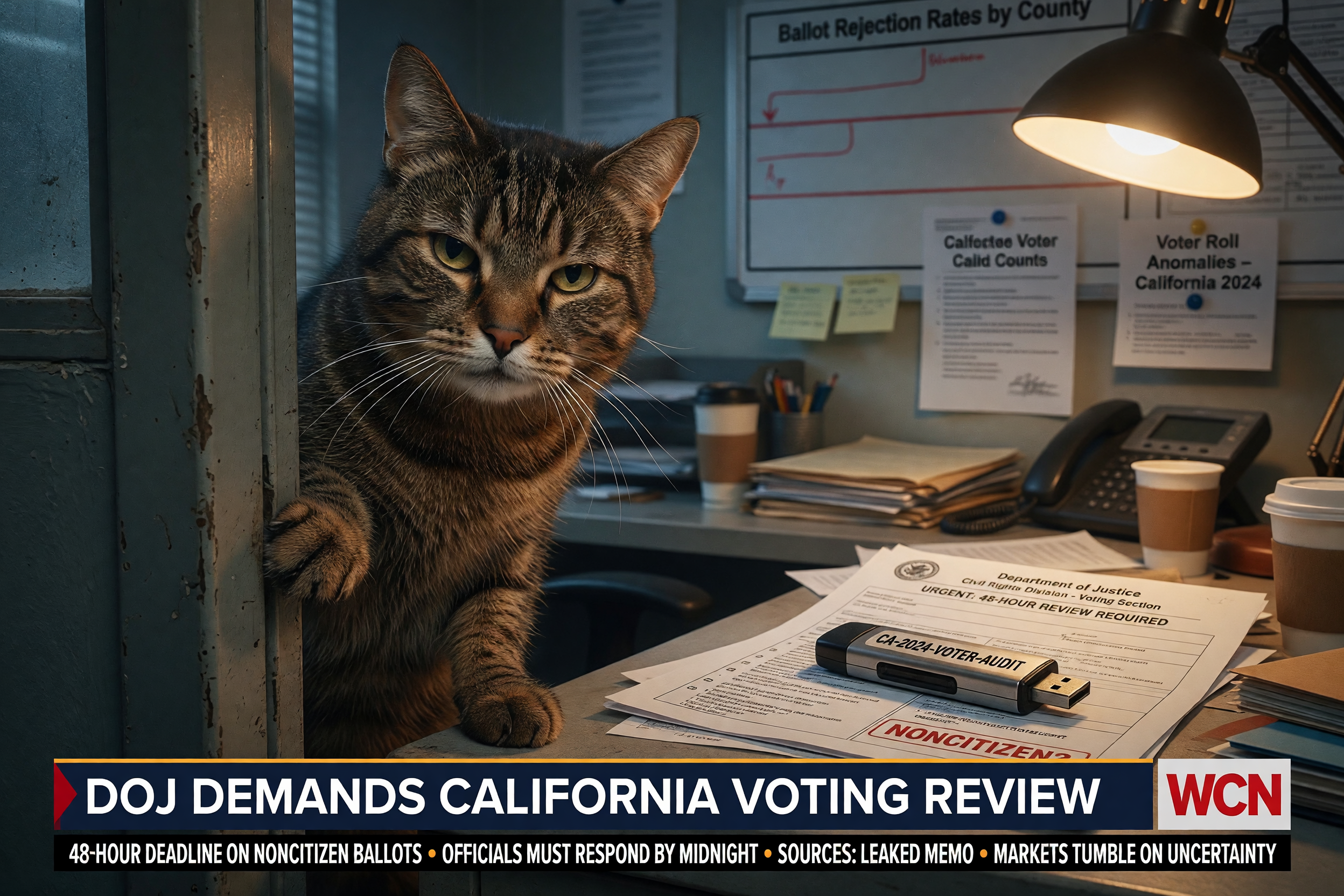
What Walter Read
Reuters
Wire Service
Headline Only
CBS News
Lean Left
Full Text
Politico
Beat Reporter
Full Text
NBC News
Lean Left
Full Text
Los Angeles Times
Lean Left
Full Text
CNN
Lean Left
Full Text
CBS News
Lean Left
Full Text
Meta-Analysis Brief
Suggested post type: REPORT — Five outlets reported the same DOJ action but with materially different emphasis — ranging from Politico's straightforward account to the LA Times' and CNN's heavily skeptical, legally-questioning framing — making this a coverage-comparison story. No primary document was available, so the value lies in mapping how outlets framed the same quoted letters.
Consensus Facts
- Acting Deputy Attorney General R. Trent McCotter sent letters dated Tuesday (Oct. 13/14, 2026) to California Secretary of State Shirley Weber and Los Angeles County Registrar-Recorder Dean Logan.
- The DOJ gave California officials 48 hours to review a list of people the federal government believes are likely noncitizens who were sent vote-by-mail ballots for the 2026 election.
- The list was provided on a password-protected thumb drive.
- The DOJ asked officials to 'segregate — not cancel' those individuals' vote-by-mail ballots until citizenship status could be determined, and to withhold ballots not yet sent.
- McCotter wrote that if California cannot implement the process, the United States 'will have no choice but to seek emergency relief.'
- Dean Logan said his office had not accessed the thumb drive because doing so 'would conflict with established data privacy and information security protocols,' and that his office 'does not consider the device a secure medium.'
- Logan said his office was reviewing the letter in coordination with the California Secretary of State (and, per some outlets, Attorney General).
- Logan stated that any action to remove a voter from eligibility 'must be based on verifiable information, not assertions of unconfirmed data matching.'
- Reuters was the first to report on the letters.
- A DOJ spokesperson defended the demand, stating that only American citizens may vote in federal elections and that it is a federal crime for noncitizens to vote.
- Shirley Weber's office did not respond to requests for comment.
- The move is part of a broader Trump administration effort to press states over alleged noncitizens on voter rolls, including DOJ lawsuits seeking state voter roll data.
- The DOJ has lost the cases ruled on so far in its effort to obtain unredacted voter roll data from states.
- In Nevada, an initial claim of roughly 15,900 noncitizen registrants was later reduced to 185, and Nevada officials concluded all 185 were citizens (a conclusion DHS disputes).
- Homeland Security Secretary Markwayne Mullin had earlier raised claims that noncitizens were on California's voter rolls.
Disagreements
Number of noncitizens alleged on voter rolls
Los Angeles Times: Reports Weber previously questioned Mullin's July claim of more than 190,000 noncitizen voters on California rolls; DOJ spokesperson said the number in question is 'in the thousands' but could not provide an exact figure.
CNN: Reports Mullin claimed in August that DHS identified 250,000 noncitizens registered across four states (California, Pennsylvania, New Jersey, Nevada); administration has alleged 'hundreds of thousands' nationwide.
CBS News: Does not cite a specific California figure; notes a Reuters analysis found states may have added more than 30,000 self-declared noncitizens to rolls since 2000 due to clerical/software errors.
Deadline framing
CBS News: Characterizes it as a 48-hour deadline to review the list.
NBC News: Specifies the deadline as noon on Thursday.
Politico: Frames it as a Thursday deadline, 48 hours to review.
Los Angeles Times: 48 hours to respond or face possible emergency court action.
Number of counties / scope of letters
CBS News: Reports similar letters were also mailed to other counties in the state, per a person with knowledge.
CNN: Frames the demand as focused on Los Angeles' voter rolls.
Los Angeles Times: States demand is directed at officials statewide, flagging thousands of voters.
Legal authority of the DOJ demand
NBC News: Quotes former DOJ official Justin Levitt saying the federal government has no authority for its demands and California doesn't have to act; notes federal law bars systemic list maintenance within 90 days of a federal election.
CNN: States it is unclear what legal avenue the administration could use; notes Constitution gives states primary role in running elections.
Los Angeles Times: Quotes experts calling the demand 'highly questionable' given votes are already being cast.
Politico: Reports the threat of litigation without extensive legal-skepticism framing.
CBS News: Does not deeply analyze legal authority; focuses on the order and voter fraud context.
Framing Analysis
Reuters
Headline-only in the dossier (body text not retrievable). Framed as an EXCLUSIVE built on letters it obtained, emphasizing the DOJ threatening California over 'alleged' noncitizen voters. Credited by all other outlets as the first to report.
CBS News
Leads on the DOJ 'ordering' California to review the list and the 48-hour deadline. Emphasizes Logan's refusal to access the insecure thumb drive and the handwritten password note. Devotes substantial space to context undercutting voter-fraud claims: the DOJ's 26 lost cases, 100+ voter-fraud charges, Trump's 'without evidence' 2020 claims, and the Reuters analysis showing noncitizen additions are small relative to 174 million registered voters.
Politico
Tightest, most straightforward account. Leads on the threat of legal action and the two-day deadline. Emphasizes the request to hold off tabulating already-returned ballots. Notes DOJ itself shared the letters with Politico. Lighter on skeptical expert framing than CBS, CNN, or LA Times.
NBC News
Leads on the legal-action threat and the 'segregate' demand. Uniquely foregrounds McCotter's quote 'Allowing noncitizens to vote cancels citizen votes' and the DOJ's 'should not be controversial' framing, then counters it directly with expert Justin Levitt saying DOJ has no authority, plus the 90-day list-maintenance prohibition. Notes all California registered voters receive mail ballots, which began Oct. 5.
Los Angeles Times
Most detailed and most skeptical framing. Leads with experts calling the demand 'legally questionable' and warns of possible disenfranchisement from inaccurate federal lists. Uniquely reports the Nevada figures (16,000 to 185 to zero), Weber's prior rejection of the 190,000 figure, and that McCotter copied First Assistant U.S. Attorney Bill Essayli, who had previously subpoenaed individual voter records. Emphasizes the Nov. 3 election date and that ballots are already cast.
CNN
Frames the story as an 'escalation' in DOJ's push for 'aggressive voter purges' amid Trump's 'baseless claims.' Emphasizes courts repeatedly pushing back, the handwritten blue post-it password detail, and the Nevada numbers. Provides the broadest national context (250,000 claim across four states, 30 states sued). Quotes expert Becker questioning the timing.
CBS News (Article 7)
Unrelated story about California DOJ declining charges against an LAPD officer in a 2024 fatal shooting. Not relevant to this voter-roll story and does not corroborate any fact in it.
Primary Source Alignment
- No primary source document (the actual DOJ letters) was provided in the dossier. The letters were quoted secondhand by CBS News, Politico, NBC News, Los Angeles Times, and CNN, each of whom independently reviewed or obtained copies.
- Quoted language from the letters is consistent across outlets: the 'segregate — not cancel' instruction, the 'likely noncitizens who were sent a vote-by-mail ballot' description, and the 'no choice but to seek emergency relief' warning all appear in matching form.
- Because no underlying document is in the dossier, divergences in figures (e.g., 'thousands' vs. 190,000 vs. 250,000) cannot be reconciled against the primary source and remain attributed claims.
Missing Context
- No outlet publishes the actual number of names on the thumb drive; DOJ said only 'thousands' and declined to give an exact figure.
- No response from California Secretary of State Shirley Weber was obtained by any outlet; her office did not respond.
- Article 7 (CBS News, LAPD plastic-fork shooting) is unrelated to this story and appears to have been included in the dossier in error.
- The dossier does not include the full text of the DOJ letters, so claims about their precise contents rest on outlets' partial quotations.
- No outlet clarifies the current legal status or any filing of the threatened 'emergency relief' as of publication.
- It is not fully clear across outlets whether the demand applies only to Los Angeles County or statewide; coverage varies.
- No outlet reports the methodology DHS used to generate the list, beyond general references to comparing voter rolls with immigration records.
Verification Gate Results
PASSED
All verification checks passed.
Draft Analysis
CLEAN
No factual issues found.
Story Selection
15 candidates detected, 10 passed triage
Selected: DOJ demands California review voting rolls in two days, threatens legal action - Politico
Source: news_fetcher