Putin agrees to resume three-way talks on Ukraine war with Kyiv and Washington, Kremlin says - AP News
The Post
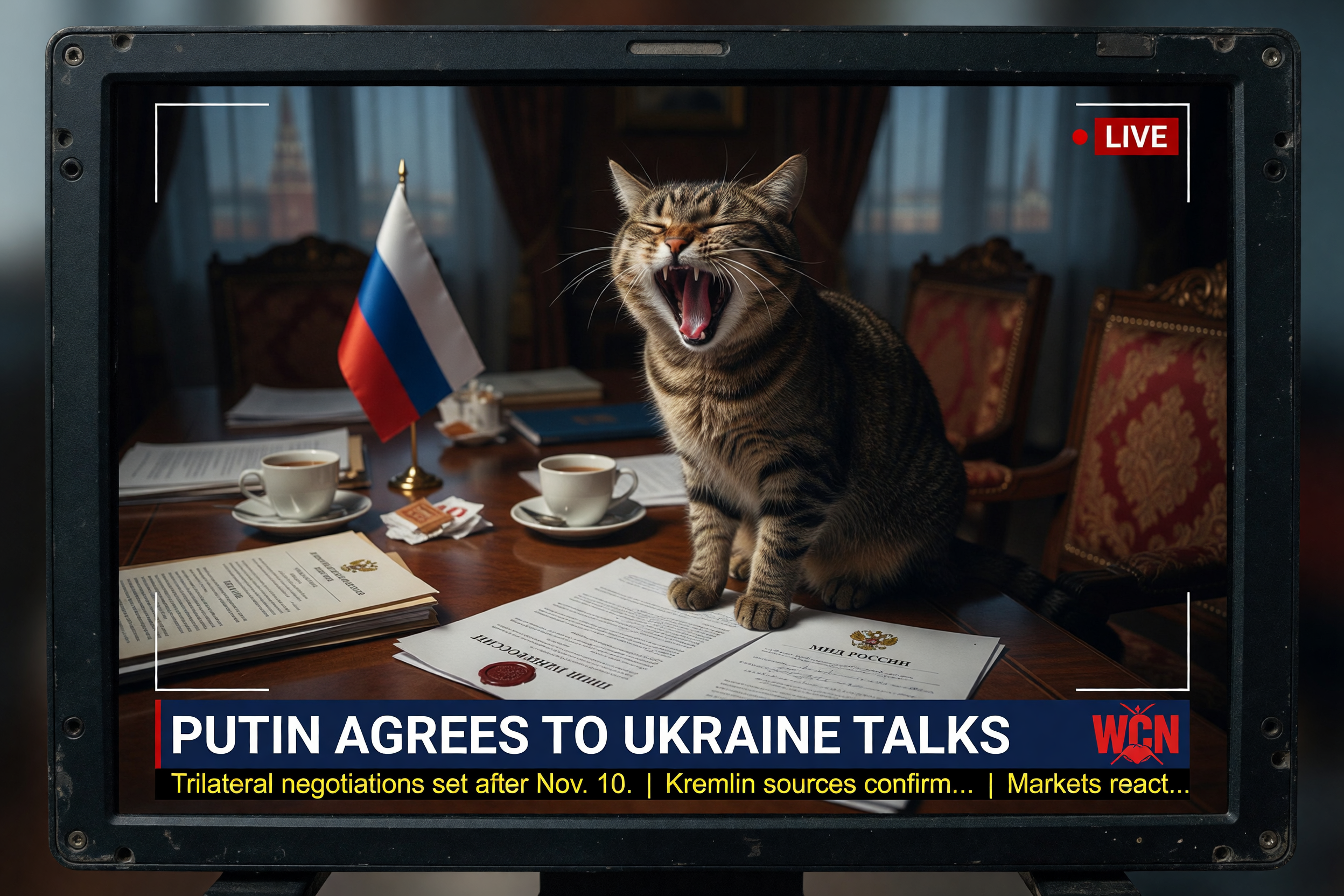
Putin agreed "in principle" to trilateral talks with Washington and Kyiv after Nov. 10, per the Los Angeles Times. The ~3-hour meeting in St. Petersburg also produced the release of American Stephen Hubbard, jailed 4+ years.
And that's the mews.
And that's the mews.
What Walter Read
Reuters
Wire Service
Headline Only
Los Angeles Times
Lean Left
Full Text
The Washington Post
Lean Left
Headline Only
The New York Times
Lean Left
Headline Only
news.google.com
Full Text
The Irish Times
Full Text
Meta-Analysis Brief
Suggested post type: REPORT — Multiple outlets covered the same Oct. 21 event but with sharply divergent framings — from Putin's talks concession (AP/LAT) to Trump pushing Ukraine to 'surrender' (NYT) to restored intelligence sharing (WaPo) — and the core 'agreement' rests on single-side Kremlin attribution with no primary readout, making this a coverage-and-sourcing story rather than a straight REPORT.
Consensus Facts
- Russian President Vladimir Putin agreed 'in principle' to resume trilateral talks with Washington and Kyiv on ending the war in Ukraine, to take place after Nov. 10.
- The agreement was announced by Putin's foreign affairs adviser Yuri Ushakov following a meeting between Putin and U.S. envoy Steve Witkoff in St. Petersburg on Wednesday, Oct. 21, 2026.
- The talks are intended to focus on 'building a security system for Russia and Ukraine' after the conflict ends.
- The Putin–Witkoff meeting lasted about three hours and took place at the Constantine/Konstantin Palace in St. Petersburg.
- No such trilateral talks have taken place since February; earlier rounds were held twice in Abu Dhabi (January and February) and once in Geneva (February), yielding little beyond prisoner exchanges.
- Witkoff met Zelensky and European leaders in Oslo, Norway, the previous day (Tuesday) before traveling to Russia.
- Russia released American Stephen Hubbard, a retired teacher roughly 74 years old jailed for more than four years on charges of fighting as a mercenary in Ukraine, after Trump asked Putin to free him.
- Witkoff stated there was 'some degree of momentum' behind peace efforts, while all accounts note there was no sign of an imminent breakthrough.
- The meeting touched on Russian diesel exports to the U.S. and on the Iran crisis, with Putin offering to help facilitate diplomacy with Tehran.
- Trump is publicly pressing Zelensky to make a deal, and Zelensky has said freezing/ceasing the conflict is the 'minimum' required and that only a leaders' summit can break the impasse.
- The two armies remain locked on the battlefield with daily long-range strikes continuing during the diplomacy.
Disagreements
Nature of Trump's pressure on Zelensky
The New York Times: Headlines that 'Trump Is Pushing Ukraine to Surrender to Russia, Zelensky Says' — frames the pressure as a demand for surrender.
Los Angeles Times: Frames it more neutrally as Trump pressing Zelensky to 'make a deal' and 'compromise.'
The Irish Times: Notes Trump has called for Zelensky to resign and portrayed him as the main obstacle to peace, but does not use the word 'surrender.'
Who ordered restrictions on Ukraine's Starshield access
The Irish Times: The Wall Street Journal reported Musk personally ordered the slowdown, while Reuters, citing sources, said the directive came from inside the White House; who ordered it remains unclear.
Los Angeles Times: Does not address Starshield restrictions.
news.google.com (AP): Does not address Starshield restrictions.
Kremlin's characterization of the Oslo proposals
news.google.com (AP): Ushakov said the Oslo proposals 'contained little of real value' but later told state TV they were 'a step in the right direction.'
The Irish Times: Ushakov said Putin 'noted some new approaches' from Europeans and Kyiv 'although they did not contain much that was useful.'
Los Angeles Times: Does not quote the Kremlin's assessment of the Oslo proposals specifically.
Overnight casualties from Russian strikes
Los Angeles Times: Reports Russian strikes killed five people in Ukraine overnight.
The Irish Times: References a related headline of 'Two killed by Russian drones near Ukraine's Kharkiv' and documents drone damage in Kyiv but does not give a consolidated overnight toll.
news.google.com (AP): Shows photos of drone damage in Kyiv but does not state a specific overnight death toll in body text.
Framing Analysis
Reuters
Headline-only in this dossier ('US envoy Witkoff to meet Putin, Trump presses Kyiv to settle'). Frames the story around Witkoff's travel and Trump's pressure on Kyiv rather than Putin's concession. No body text retrievable, so framing beyond the headline cannot be assessed.
Los Angeles Times
Full AP-sourced text. Leads with Putin agreeing 'in principle' and the security-system framing, balanced against the lack of breakthrough and ongoing strikes. Emphasizes Trump pressuring Zelensky with his 'we've gotten absolutely nothing back except grief, death' quote. Notes the Hubbard release and diesel deal as goodwill gestures. Comparatively even-handed wire tone.
The Washington Post
Headline-only ('U.S. restores intelligence sharing with Ukraine, Zelensky says'). Frames the day's news around a repair in U.S.-Ukraine ties rather than Putin's talks concession — a different angle emphasizing American re-engagement with Kyiv. Body text not retrievable.
The New York Times
Headline-only ('Trump Is Pushing Ukraine to Surrender to Russia, Zelensky Says'). Sharpest framing of the set, foregrounding Zelensky's accusation that Trump is pushing for surrender and centering the U.S.-Ukraine rift rather than the resumed-talks announcement. Body text not retrievable.
news.google.com (AP)
Full AP wire text (the canonical source most others draw on). Leads with Putin agreeing to resume three-way talks, potentially the first since February. Prominently includes the Hubbard release framed as occurring amid 'actions meant to benefit Moscow,' the Kremlin's mixed read on the Oslo proposals, and Putin's warm China meeting. Neutral wire phrasing with related links on the U.S.-Ukraine low point.
The Irish Times
Full text, most detailed on the U.S.-Russia warmth and U.S.-Ukraine friction. Emphasizes Witkoff calling Putin 'a humanitarian,' Hubbard being released unilaterally 'with no swap,' Trump's Truth Social claim, and the diesel-sanctions dispute. Frames the release as a 'calculated move to bring Trump further into line with Putin's position' ahead of midterms. Most skeptical tone toward the U.S.-Russia rapprochement; surfaces the Starshield and intelligence-sharing disputes.
Primary Source Alignment
- No primary sources (transcripts, official readouts, or filings) were located for this story. All reporting traces to Kremlin spokesman Yuri Ushakov's remarks to reporters and state TV, plus Witkoff and Trump statements — meaning the 'in principle' agreement rests on a single-side (Russian government) attribution that cannot be independently verified against a document in this dossier.
Missing Context
- No Ukrainian confirmation that Kyiv has agreed to attend the post-Nov. 10 trilateral talks; the entire 'agreement' is sourced to the Kremlin, with no primary readout.
- The content of the 'papers'/peace-deal ideas Witkoff presented to Putin is not disclosed by any outlet; readers cannot assess what is actually on the table.
- The two outlets with full text (Los Angeles Times and the AP item on news.google.com) both draw on the same AP wire, so their agreement is effectively single-sourced rather than independent corroboration.
- No outlet details what concrete concessions, if any, Russia has made on territory or ceasefire terms beyond agreeing to meet — the diplomacy's substance remains unclear.
- The dispute over who ordered the Starshield slowdown (Musk per WSJ vs. the White House per Reuters) is unresolved and only surfaced by The Irish Times; the LAT and AP texts omit it entirely.
- The Washington Post and Reuters headlines point to materially different story angles (restored intelligence sharing; Trump pressing Kyiv) whose full reporting is unavailable, limiting the dossier's view of the U.S.-Ukraine side.
- No independent casualty verification; the overnight death toll ('five people' per LAT) is attributed to officials without cross-confirmation.
Verification Gate Results
PASSED
All verification checks passed.
Draft Analysis
CLEAN
No factual issues found.
Story Selection
15 candidates detected, 14 passed triage
Selected: Putin agrees to resume three-way talks on Ukraine war with Kyiv and Washington, Kremlin says - AP News
Source: news_fetcher