Israel Election Live Updates: Record Voter Turnout as Netanyahu Faces Challenge Led by Eisenkot - The New York Times
The Post
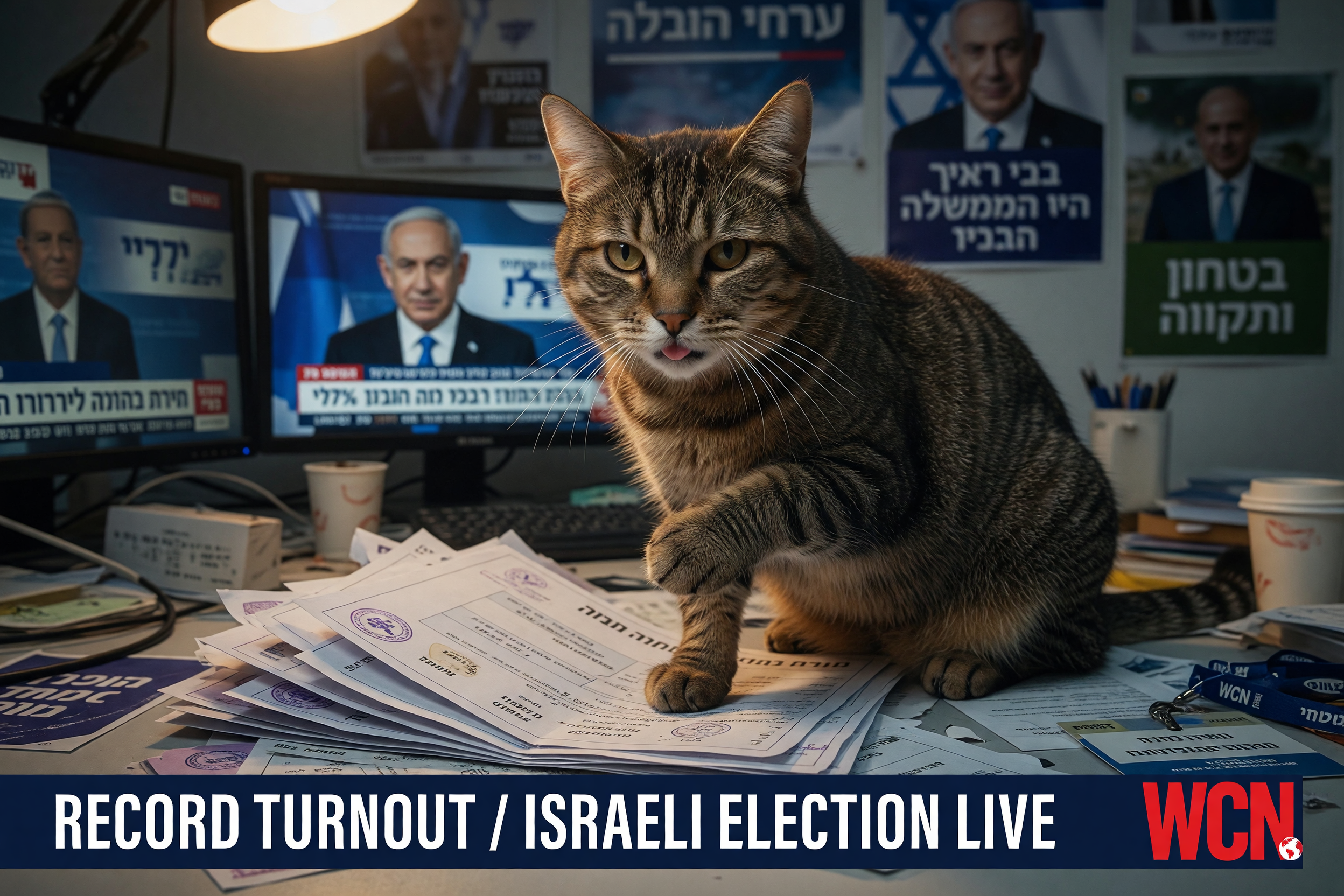
Israel voted today in its first election since Oct. 7, 2023. BBC News reports turnout is the highest on record. Netanyahu faces challenger Gadi Eisenkot. No bloc is projected to reach 61 seats.
And that's the mews.
And that's the mews.
What Walter Read
Reuters
Wire Service
Headline Only
CNN
Lean Left
Full Text
BBC News
International
Full Text
Reuters
Wire Service
Full Text
Al Jazeera English
International
Full Text
Al Jazeera English
International
Full Text
Al Jazeera English
International
Full Text
Meta-Analysis Brief
Suggested post type: REPORT — Four outlets covered the same election with materially different framings — Reuters flatly says Netanyahu's bloc trails while BBC calls it neck-and-neck, and Al Jazeera foregrounds a 'genocidal war' and Arab voter-suppression angle that CNN and Reuters largely omit — making the divergence in emphasis the real story. No primary source was available and no outcome yet exists, so this is a coverage-comparison piece rather than a straight REPORT.
Consensus Facts
- Israel held a national election on October 27, 2026, its first since the Hamas-led attack of October 7, 2023 (CNN, BBC, Reuters, Al Jazeera).
- The election is widely framed as a referendum on Prime Minister Benjamin Netanyahu's handling of the October 7 attack and the wars that followed in Gaza, Lebanon and Iran (CNN, BBC, Reuters, Al Jazeera).
- Netanyahu's principal challenger is Gadi Eisenkot, a former military chief of staff who leads the new centrist party Yashar (CNN, BBC, Reuters, Al Jazeera).
- Polls indicate neither Netanyahu's bloc nor the opposition is projected to win the 61 seats needed to form a government, meaning coalition negotiations of weeks or months may follow (CNN, BBC, Reuters).
- Netanyahu's bloc relies on far-right parties (led by Bezalel Smotrich and Itamar Ben-Gvir) and ultra-Orthodox parties (SHAS, UTJ) (CNN, BBC, Reuters).
- The opposition 'change bloc' is ideologically fragmented, including Naftali Bennett and Avigdor Lieberman on the right and Yair Golan's Democrats on the left (CNN, BBC, Reuters).
- Turnout on election day was reported as the highest on record / highest in roughly 50 years (BBC, Al Jazeera).
- Palestinian citizens of Israel make up roughly 20 percent of the population and traditionally vote at lower rates; this cycle their turnout was reported as unusually high (CNN, BBC, Al Jazeera).
- Both Netanyahu and Eisenkot have ruled out partnering with Arab parties (CNN, BBC, Al Jazeera).
- Netanyahu's Likud requested that voting hours be extended beyond 10 p.m., and his camp framed high Arab turnout as an emergency (BBC, Al Jazeera).
- Israel uses a proportional representation system with a 3.25% electoral threshold for the 120-seat Knesset (CNN, Al Jazeera).
Disagreements
Who leads in pre-election polling
CNN: Channel 12 poll puts Eisenkot first with 23 seats ahead of Likud's 21; pro-Netanyahu Channel 14 projects Likud at 30 and Eisenkot at about 20; describes polling as mixed.
BBC: Friday polling shows Netanyahu 'almost neck-and-neck' with Eisenkot.
Reuters: States 'Netanyahu bloc trails rivals in polls ahead of the election.'
Specific turnout figures
BBC: Turnout so far is the highest on record (no specific percentage cited).
Al Jazeera: 66.7% of eligible Israelis had voted by 6pm (vs 57.7% at same time in 2022); soldier turnout above 68% by 5pm; characterizes it as highest in 50 years, possibly surpassing the 1973 peak.
CNN: Does not cite election-day turnout figures (published before polls); cites 2022 figures of 70.6% general and 53.2% Arab turnout.
Voting irregularities and extension of hours
BBC: Likud asked for voting to be extended beyond 22:00; Eisenkot's camp called it an attempt to lay groundwork for challenging election integrity; CEC found no evidence of systematic ballot tampering.
Al Jazeera: The Central Elections Committee rejected Likud's request to extend hours; emphasizes a civil-rights group (ACRI) complaint of possible voter suppression and delays in at least 18 Arab communities, plus heavy police presence in a Negev polling station.
CNN: Does not address election-day irregularities (published pre-vote).
Characterization of the Gaza war
Al Jazeera: Refers to 'the genocidal war in Gaza' and to Palestinians under 'occupying power.'
BBC: States Israeli military has killed more than 74,000 people per Gaza's Hamas-run health ministry (figures considered reliable by the UN); notes international condemnation and that West Bank settlements are illegal under international law.
CNN: Describes 'wars that followed in Gaza, Lebanon and Iran' and 'deepened Israel's international isolation' without casualty figures or 'genocide' framing.
Reuters: Neutral descriptions of 'wars in Gaza, Lebanon and Iran' with no casualty count.
Reported last-minute military action toward Iran
BBC: Reports Channel 12 said Netanyahu pushed for last-minute military action risking confrontation with Iran but was opposed by military chief Eyal Zamir; CNN reportedly said he tried to persuade Trump to strike Iran but Trump refused; Netanyahu denied both.
CNN: The dossier's CNN article does not contain this claim in its body text (though BBC attributes a related report to CNN).
Reuters: Does not mention.
Al Jazeera: Does not mention.
Framing Analysis
Reuters
Two Reuters items in the dossier: one is headline-only ('What happens after polls close?'), the other is a results/graphics explainer. The explainer leads with process and the 10 p.m. close, then offers a party-by-party guide. Notably states flatly that 'Netanyahu bloc trails rivals in polls' — a stronger single assertion than CNN's or BBC's hedged polling language. Uses pointed descriptors for Netanyahu's partners (e.g., Ben-Gvir 'convicted in 2007 of racist incitement,' Smotrich's hope to 'bury' a Palestinian state) while also noting Likud's popularity 'plummeted' after October 7. Neutral wire tone but factually detailed on each party.
CNN (lean-left)
Published pre-vote (Oct 25) as a 'what's at stake' explainer. Frames the election as 'one of the most significant in its history' and a referendum on Netanyahu, emphasizing the judicial overhaul, corruption trial, and the shift toward a 'nationalistic, conservative and religious direction.' Leads on the democracy-vs-direction stakes and the coalition math. Gives detailed, competing poll numbers from both Channel 12 and pro-Netanyahu Channel 14, showing care about source balance. Buries casualty figures (none given) and election-day events (predates them).
BBC News (international)
Leads hard on the record turnout and the 'pivotal' framing. Balances Netanyahu's 'Mr Security' self-framing against opposition attack lines. Most comprehensive on controversy: the vote-extension fight, the AI nuclear-bomb image, the reported Iran-strike push, conscription, and the corruption trial. Includes the 74,000 Gaza death toll (Hamas-run ministry, 'considered reliable by the UN') and flags West Bank settlements as 'illegal under international law' and settler attacks 'at an all-time high.' Places Netanyahu's Arab-turnout 'emergency' posts prominently.
Al Jazeera English (international)
Three items, two near-headline-only ('begin voting,' 'Jerusalem Daily'). Distinctive framing: explicitly calls the Gaza war 'genocidal,' foregrounds that Palestinians in the West Bank and Gaza 'have no say in which occupying power will govern their lives,' and centers possible voter suppression of Arab citizens — ACRI's complaint about delays in 18 communities and police presence in the Negev. Leads the turnout story with the suppression angle in its subhead. Cites the hardest turnout numbers (66.7% by 6pm) and the 1973 comparison, and quotes Smotrich's and Netanyahu's 'the right or Palestine' mobilization rhetoric critically.
Primary Source Alignment
- No primary sources (official CEC tallies, court filings, party releases in full) were located for this story. All turnout figures, poll numbers, and procedural claims rest on outlet reporting attributed to the Central Elections Committee, pollsters, and party statements, which could not be independently verified against an underlying document in this dossier.
Missing Context
- No final or provisional seat results are in the dossier — all articles were filed before or during voting, so no outlet reports an actual outcome.
- The 74,000 Gaza death toll appears only in BBC (attributed to the Hamas-run health ministry); no outlet provides an independent verification or a competing figure, and CNN/Reuters omit casualty numbers entirely.
- The ACRI voter-suppression complaint and the reported Iran-strike push are each carried by only one outlet (Al Jazeera and BBC respectively); readers are not given corroboration or official responses beyond Netanyahu's denial.
- No outlet in the dossier reports the official response of the Central Elections Committee to the ACRI suppression complaint, only that it was filed.
- Three of the seven dossier items (Reuters headline-only, Al Jazeera 'begin voting,' Al Jazeera 'Jerusalem Daily') are near-headline-only with little or no body text, limiting independent corroboration for some election-day details.
- No primary source (official CEC turnout data, poll crosstabs, or full party platforms) was available; editorial disclosure that turnout and polling figures are reported secondhand.
- Outlets diverge sharply on language for the Gaza war ('genocidal war' in Al Jazeera vs neutral 'wars' in Reuters/CNN) without any shared verifiable standard, which a reader should know reflects editorial choice rather than an agreed fact.
Verification Gate Results
PASSED
All verification checks passed.
Draft Analysis
CLEAN
No factual issues found.
Story Selection
15 candidates detected, 14 passed triage
Selected: Israel Election Live Updates: Record Voter Turnout as Netanyahu Faces Challenge Led by Eisenkot - The New York Times
Source: news_fetcher