Spain train crash kills at least 68 as witnesses describe devastating scenes - CNN
The Post
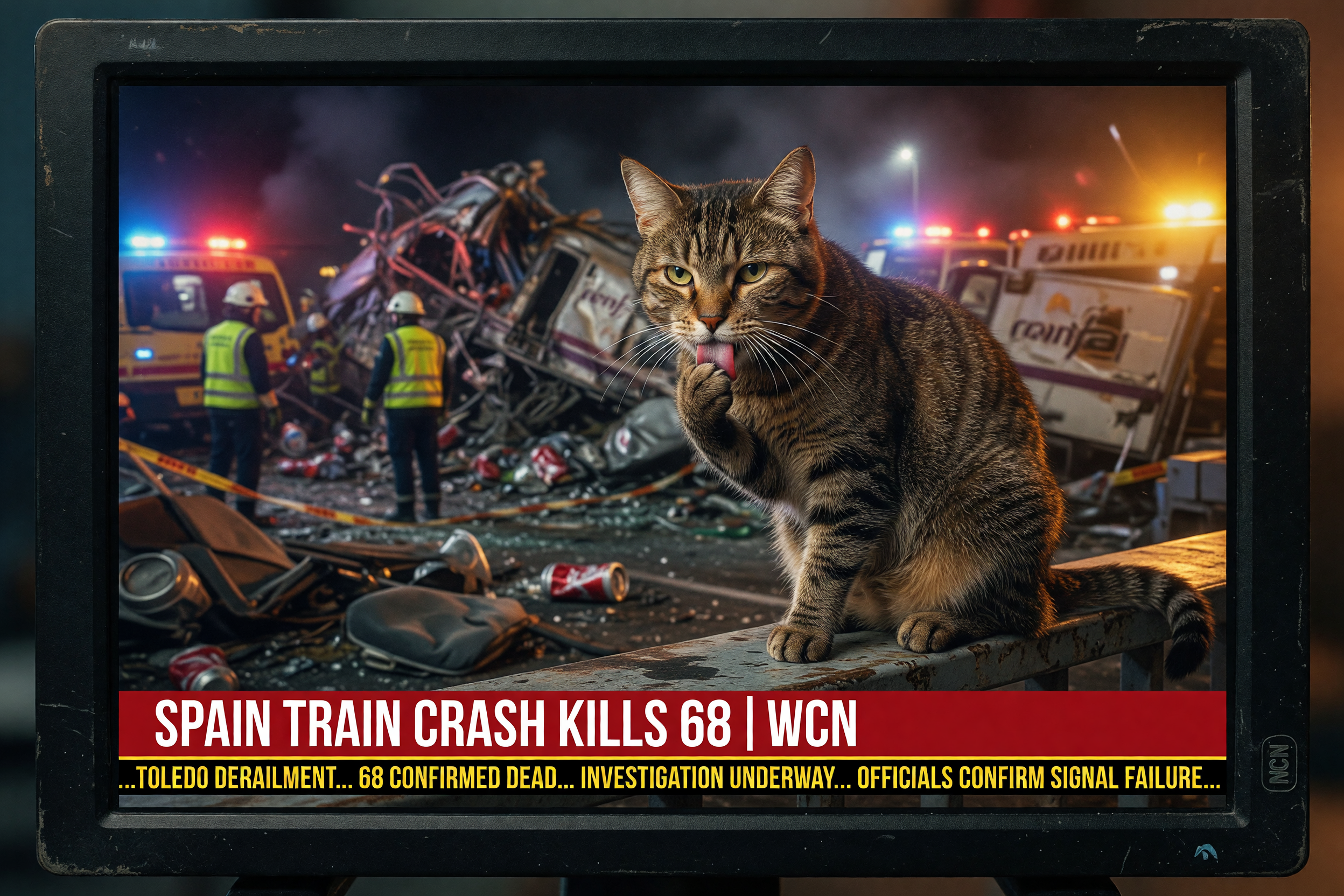
#BreakingMews At least 68 dead after a RENFE train struck a stopped IRYO train in Toledo province Wednesday, AP and Reuters report. Spain's deadliest rail disaster since 2013. PM Sánchez declared three days of national mourning.
And that's the mews.
And that's the mews.
What Walter Read
The New York Times
Lean Left
Full Text
Reuters
Wire Service
Headline Only
Associated Press
Wire Service
Full Text
Al Jazeera English
International
Full Text
CNBC
Beat Reporter
Full Text
Reuters
Wire Service
Full Text
Meta-Analysis Brief
Suggested post type: REPORT — Multiple outlets reported the same event with materially different death tolls (30 vs. 68), injury counts, timelines, and framing emphases (scene imagery vs. mechanical reconstruction vs. political fallout), reflecting a fast-moving developing story where coverage snapshots diverge. No primary source was available, making a comparison-of-coverage post more honest than a straight REPORT.
Consensus Facts
- A high-speed train operated by state-owned RENFE struck the rear of a stopped high-speed train operated by private company IRYO in Toledo province, central Spain, on Wednesday, Oct. 28, 2026.
- The collision occurred on the Madrid–Seville (Madrid–Andalusia) high-speed line, near the town of Urda, roughly 118–150 km south of Madrid.
- At least 68 people were killed, according to authorities (the AP, Reuters, CNBC and Reuters graphics all cite this figure).
- Dozens were injured, with figures reported around 50 to nearly 80 across outlets.
- The crash is Spain's second deadly high-speed rail collision of 2026, following a January crash on the same route/system.
- Spanish Prime Minister Pedro Sánchez traveled to or addressed the scene, said 'all of Spain is grieving,' and said any negligence would come to light; he declared three days of national mourning.
- Transport Minister Óscar Puente said a computer/communications security system failure automatically stopped trains, and that an 'inexplicable'/erroneous decision to restart the RENFE train despite an active stop (red) signal caused the crash.
- High-speed rail service between Madrid and Andalusia was suspended following the crash.
- Spain faces a snap national election on Nov. 29, 2026, which Sánchez called amid unrest over the housing crisis.
- The crash is Spain's deadliest rail disaster since the 2013 derailment.
Disagreements
death toll
Associated Press: At least 68 killed (body also references an early figure of 64 in a photo caption).
Reuters: At least 68 dead.
CNBC: At least 68 dead.
Al Jazeera English: At least 30 killed (earlier count, cites regional president García-Page, warns toll could rise).
Bloomberg (headline-only): At least 30 killed south of Madrid.
number injured
Associated Press: Dozens injured; 58 receiving hospital treatment.
CNBC: 50 people injured.
Reuters (graphics): Nearly 80 injured.
Al Jazeera English: At least 80 injured.
January 2026 crash death toll
Associated Press: Describes it as another deadly crash by the same two companies (no specific number given in body).
CNBC: 45 people killed in January.
Al Jazeera English: 45 people killed in January.
Reuters (graphics): 46 people killed on Jan. 18, 2026.
distance train traveled after restart before impact
Associated Press: Security system stopped working on a 63 km stretch; train restarted and collided at 8:53 a.m.
CNBC: Six trains stopped; one restarted and travelled 25 km before hitting the stopped train.
casualties by train operator
CNBC: 24 people died on the RENFE train, the rest on the IRYO train (per regional president García-Page).
Reuters (graphics): 397 people were on the RENFE train and 147 (including a baby) on the IRYO train; does not break down deaths by train.
time of collision
Associated Press: Collision at 8:53 a.m. after security system failed at 8:30 a.m.
CNBC: Trains collided shortly before 9:15 a.m. local time.
Reuters (graphics): Collision just before 9:00 a.m. (0800 GMT).
Framing Analysis
The New York Times
Appears only as a Google News RSS aggregation cluster (a list of links to other outlets) rather than retrievable NYT body text. The NYT headline ('A Twisted Tangle of Metal and Wreckage') leads on visceral scene imagery. No substantive NYT body text was available to analyze.
Reuters
Two entries: one headline-only ('Spain's second major train crash this year'), one a detailed graphics explainer. The graphics piece leads on the mechanical sequence — computer failure, erroneous restart despite red signal, breaking protocol — and provides precise passenger counts (397 RENFE, 147 IRYO including a baby). Clinical, reconstruction-focused wire framing emphasizing how the crash unfolded and linking it to the January crash on the same line.
Associated Press
Leads on the human toll and the 'inexplicable' order from central command, explicitly stating engineers were not to blame. Foregrounds vivid survivor and bystander testimony (British tourist Samy Paul, construction worker David Gómez), Sánchez's mourning declaration, and the political stakes (election Nov. 29). Balances technical cause with ground-level devastation.
Al Jazeera English
A photo gallery ('In Pictures') published early with a lower death toll of 30, attributed to regional president García-Page, explicitly warning the toll could rise. Emphasizes imagery and rescue operations; frames the event within Spain's rail-safety history (January crash, 2013 derailment). Reflects an earlier reporting snapshot.
CNBC
Business-news framing that leads with key points but gives significant space to the political dimension: Sánchez's snap election, the housing-crisis backdrop, and far-right Vox leader Santiago Abascal's attack on the government ('neglect, ruin, betrayal'). Uniquely details the operator-by-operator death split (24 RENFE) and the restart-and-25km detail. Most politically framed of the full-text sources.
Bloomberg.com
Headline-only in the dossier, reporting an early figure of 'at least 30 killed south of Madrid.' No body text available to analyze; headline reflects an earlier death-toll snapshot.
Primary Source Alignment
- No primary source (official accident report, ADIF/Civil Guard statement, or transcript) was located for this story. Reuters notes its diagram sources as the Spanish Civil Guard and the National Geographic Institute, but no underlying document was provided in the dossier.
- The official cause attribution rests entirely on Transport Minister Óscar Puente's public remarks as relayed by AP, CNBC and Reuters; it is a government-official account, not a verified independent investigation. ADIF/Adif is reported to be investigating.
Missing Context
- No outlet provides the final confirmed death toll; figures ranged from 30 (early Al Jazeera/Bloomberg) to 68, with authorities cautioning the count could rise. The brief reflects a developing-story snapshot.
- The underlying technical cause — why the central command restarted the RENFE train despite an active stop signal, and whether the computer/communications failure was human error, software fault, or systemic — is asserted by the Transport Minister but not independently confirmed by any investigation in the dossier.
- No outlet explains why the same two companies (RENFE and IRYO) and/or the same line were involved in both 2026 crashes, or whether a common systemic factor links them.
- Little detail on the speed of the RENFE train at impact; AP says it 'could have been' 200 kph but authorities were still studying it.
- Coverage does not clarify discrepancies in the exact collision time (8:53 a.m. vs. before 9:00 a.m. vs. before 9:15 a.m.) or in the distance traveled after restart (25 km vs. a 63 km failed stretch).
- No independent verification of the operator-by-operator casualty breakdown (CNBC's 24 RENFE deaths) was available from other outlets.
- The political framing (Vox's attack, the Nov. 29 election) is reported by CNBC but the broader context of how rail safety is figuring into the campaign is not developed across outlets.
Verification Gate Results
PASSED
All verification checks passed.
Draft Analysis
CLEAN
No factual issues found.
Story Selection
15 candidates detected, 14 passed triage
Selected: Spain train crash kills at least 68 as witnesses describe devastating scenes - CNN
Source: news_fetcher