Ukrainian evacuees reunite with family after years trapped in Russia-occupied city - BBC
The Post
Residents of Russian-occupied Oleshky crossed into Ukrainian territory Saturday under a localized ceasefire brokered with help from Melania Trump. BBC News reports the convoy carried capacity for 750 people; several hundred chose to stay.
And that's the mews.
And that's the mews.
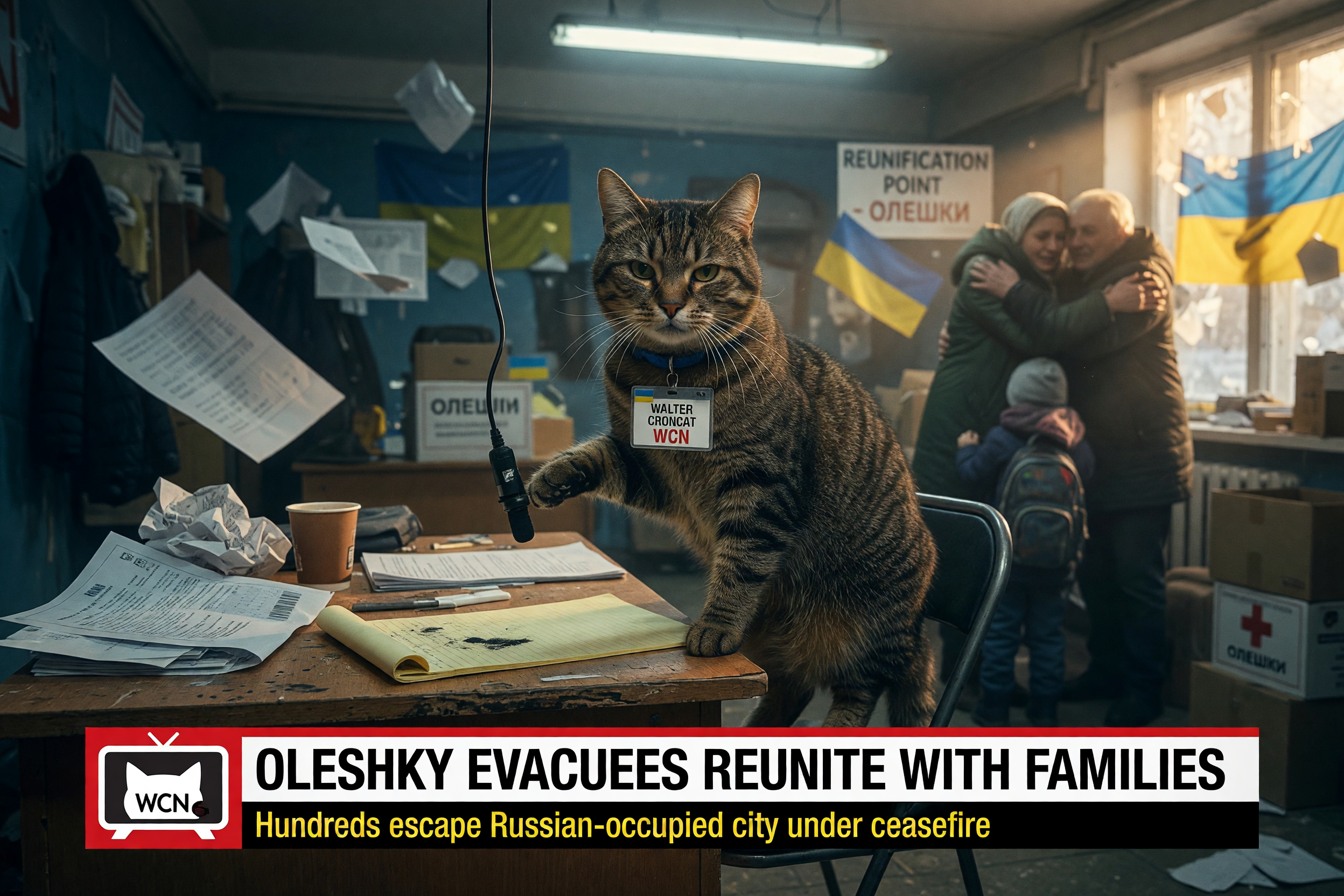
What Walter Read
BBC News
International
Full Text
BBC News
International
Full Text
CBS News
Lean Left
Full Text
ABC News
Lean Left
Full Text
Meta-Analysis Brief
Suggested post type: REPORT — Four articles across three outlets (BBC, CBS, ABC) reported the same event, but with materially different framings — BBC foregrounds skepticism about Russian political motives and the Lubinets controversy, while the AP-based CBS and ABC run more neutral, procedural accounts, and figures like remaining population and transit routing diverge. No primary source exists to adjudicate, making a coverage-comparison the most honest treatment.
Consensus Facts
- Residents of the Russian-occupied city of Oleshky in Ukraine's Kherson region were evacuated and crossed into Ukrainian-controlled territory on Saturday, October 31, 2026.
- The evacuation took place under a localized humanitarian ceasefire in the Kherson region that began at 3am local time on Tuesday and is expected to continue through Sunday evening, November 1.
- US First Lady Melania Trump was credited with helping broker the ceasefire that enabled the evacuation.
- Evacuees chose between traveling to Ukrainian- or Russian-held territory; those heading to Ukraine traveled through Russia and then flew to Homel (Gomel), Belarus, before crossing into Ukraine.
- Melania Trump posted on social media Friday that the humanitarian convoy could safely evacuate more than 750 people.
- The ceasefire is described as the longest/most significant/widespread truce since Russia's full-scale invasion of Ukraine in February 2022.
- Several hundred residents chose to remain in Oleshky despite devastation and the lack of gas, electricity, and running water.
- Russia and Ukraine did not specify exactly how many people chose to leave the city.
- Dmytro Lubinets, Ukraine's human rights commissioner/ombudsman, accompanied evacuees and became the first Ukrainian official since the start of the war to visit Russian-occupied parts of Ukraine.
- Russia said it had prepared 'dozens of tonnes' of aid (food, medicine, hygiene products, generator fuel) for residents who stayed.
- Fighting continued elsewhere in Ukraine during the localized ceasefire, including Russian strikes on Ukrainian energy and power infrastructure.
- Emotional family reunions occurred at the border, including relatives who had not seen each other for over two years.
Disagreements
Number of remaining residents in Oleshky
CBS News: Estimates an 'estimated 2,000 remaining residents' were offered the choice to leave, go to Russia, or stay.
ABC News: Also cites 'estimated 2,000 remaining residents.'
BBC News: Does not give a 2,000 figure; notes pre-war population of 24,000 and a convoy of 25 buses with space for 750 people.
Belarus transit city routing and intermediate Russian city
BBC News: Evacuees traveled through Russian-occupied territory to southern Russia, flew to Belarus (Gomel), then crossed the northern border; names Armiansk in Crimea as the setting-off point.
CBS News: Those returning to Ukraine were taken to the Russian city of Anapa, then flown to Homel in Belarus.
ABC News: Russia's Ministry of Defense said those going to Ukrainian-held territory were taken to the Russian city of Anapa and flown to Homel, Belarus.
Secondary figures credited with pressing for the evacuation
CBS News: Adds that Pope Leo XIV, the first American pontiff, also pressed Russian and Ukrainian leaders to allow aid and evacuations.
BBC News: Does not mention the Pope; emphasizes Lubinets and Lantratova cooperation.
ABC News: Does not mention the Pope.
Characterization of Russia's motives
BBC News: States many Ukrainians suspect Russia's real intention is to earn credit with the White House and boost Trump ahead of midterm elections; notes Kherson residents fear Russia is using the truce to build up military presence.
CBS News: Does not attribute political motive; frames as humanitarian mission with continued fighting elsewhere.
ABC News: Frames as 'a rare joint Russia-Ukraine humanitarian effort'; no political-motive analysis.
Identity details of the Paliy/Palii family reunions
BBC News: Names Dasha and Anya Palii reuniting with father Mykhailo, mother Zhanna; describes tarmac sprint and reunion.
CBS News: Names Liza Paliy, 19, and separately Daria Pavlyn awaiting her father Mykhailo; frames as still waiting at the border.
ABC News: Names Liza Paliy and Daria Pavlyn awaiting fathers; frames as waiting at the border.
Framing Analysis
BBC News
Two articles provided. Leads with raw human emotion — reuniting sisters, stretchers, people who ate garden weeds to survive. Provides the most operational detail (25 buses, 750-person capacity, 4-hour window, 5km frontline distance, 24km minefield walk) and the most context on pre-war population and mining. Uniquely foregrounds skepticism: that some Ukrainians 'recoiled' at Lubinets standing beside a Russian official, that Russia may be seeking White House credit and a midterm boost for Trump, and that Kherson residents fear a renewed assault after the truce. Most willing to editorialize about Russian intent while still attributing it to 'many Ukrainians.'
CBS News
AP-sourced. More procedural and sourcing-cautious; emphasizes Ukrainian restrictions on disclosing evacuee numbers and crossing locations to protect those who stayed and future missions. Adds the Pope Leo XIV angle absent elsewhere. Balances the humanitarian story with continued-fighting details, including Ukrainian drone casualties in Russia's Bryansk region and Russian strikes leaving 280,000 households without power. Frames reunions as still-pending/anxious waiting rather than completed embraces.
ABC News
AP-sourced, shortest treatment. Uses an 'In short / What's next' summary box framing it as a straightforward news event. Characterizes it as 'a rare joint Russia-Ukraine humanitarian effort, a brief respite in the grim war' — the most neutral and least skeptical framing. Leans on Russia's Ministry of Defense for routing details. Omits political-motive analysis and the Lubinets-controversy angle entirely.
Primary Source Alignment
- No primary source was located for this story. Core claims rest on BBC original reporting and AP wire copy (carried by CBS News and ABC News), plus statements attributed to Melania Trump, Lubinets, and Russia's human rights ombudsman Yana Lantratova. No independent documentary verification of evacuee numbers, ceasefire terms, or routing was available in the dossier.
Missing Context
- No outlet independently verified how many people actually evacuated versus stayed; both Russia and Ukraine declined to specify, and the 750 figure is a capacity, not a count.
- The precise terms, enforcement mechanism, and signatories of the ceasefire agreement are not detailed in any article — only that Melania Trump helped broker it and both sides agreed.
- CBS News and ABC News share an AP wire origin, so their overlapping details (Anapa routing, 2,000 remaining, Liza Paliy and Daria Pavlyn quotes, Red Cross/MSF/World Central Kitchen presence) represent one sourcing stream, not two independent confirmations.
- No outlet explains why routing accounts differ (BBC's southern Russia / Armiansk vs. AP's Anapa) or reconciles them.
- Little independent accounting of conditions or treatment for residents who chose to relocate to Russian-held territory rather than Ukraine.
- No outlet details what happens to evacuees after arrival — housing, resettlement, or medical care beyond Zelensky's general assurance of assistance.
- The upcoming Abu Dhabi ceasefire talks are mentioned only by BBC with no detail on scope or participants' positions.
- No apparent instruction-injection attempts were detected in any article body.
Verification Gate Results
PASSED
All verification checks passed.
Draft Analysis
CLEAN
No factual issues found.
Story Selection
15 candidates detected, 12 passed triage
Selected: Ukrainian evacuees reunite with family after years trapped in Russia-occupied city - BBC
Source: news_fetcher