Trump administration asks Supreme Court to set aside 20,000 California ballots for now - The Washington Post
The Post
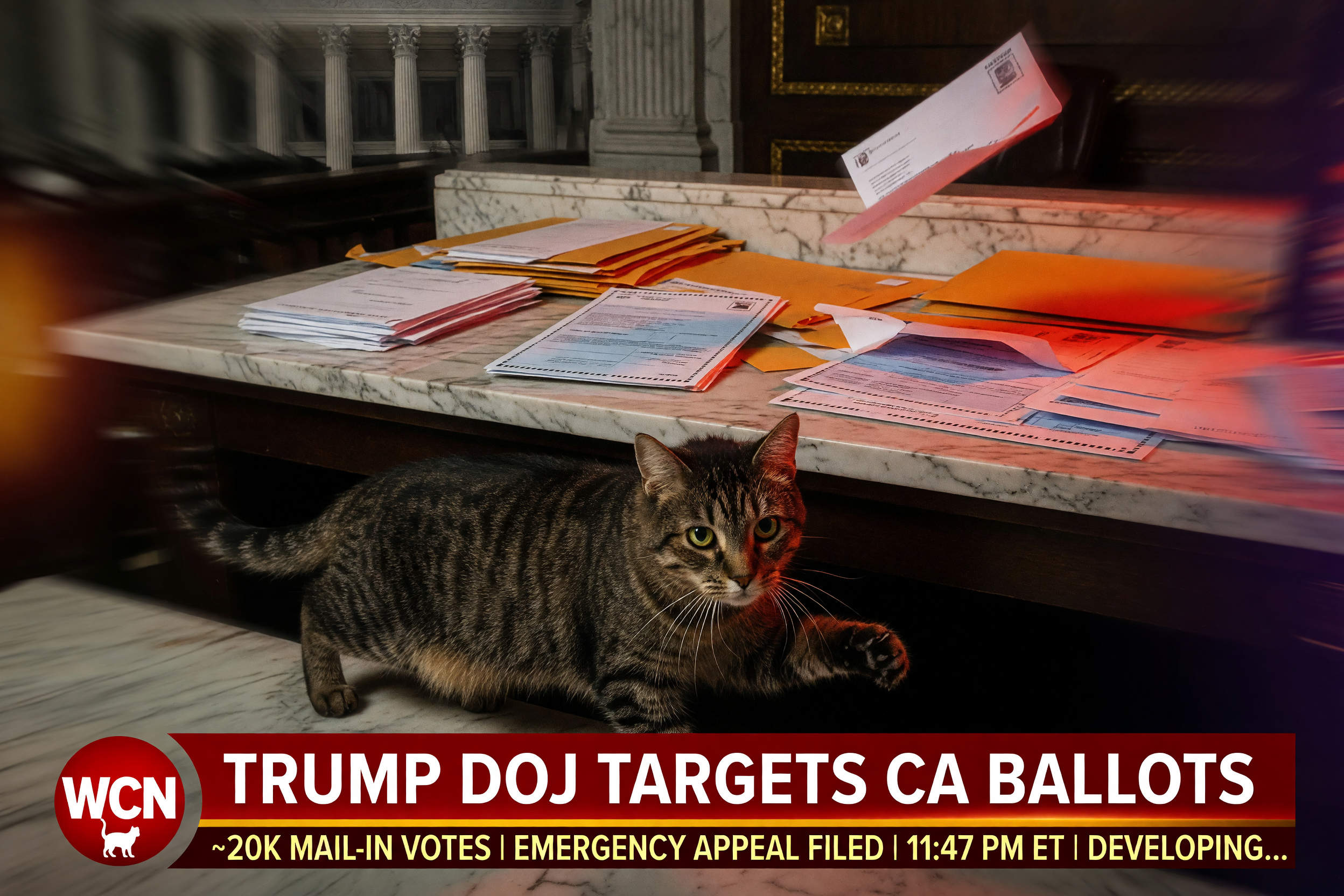
#BreakingMews: Reuters reports the Trump DOJ filed an emergency Supreme Court appeal Monday seeking to set aside ~20,000 California mail-in ballots from suspected noncitizens — one day before the November 3, 2026 midterms.
reported by Reuters, not yet confirmed elsewhere.
What Walter Read
Reuters
Wire Service
Headline Only
The New York Times
Lean Left
Headline Only
Al Jazeera English
International
Full Text
CNBC
Beat Reporter
Full Text
Associated Press
Wire Service
Full Text
Bloomberg
Wire Service
Headline Only
CNN
Lean Left
Full Text
Meta-Analysis Brief
Suggested post type: REPORT — Four outlets with usable text reported the same Supreme Court appeal but with materially different emphasis — AP surfaced a parallel Elections Clause ruling others omitted, CNN foregrounded the Purcell principle and conservative majority, Al Jazeera uniquely named Justice Kagan, and CNBC gave the DOJ's legal theory the most space — making this a coverage-divergence story rather than a straightforward REPORT.
Consensus Facts
- On Monday, November 2, 2026, the Trump administration/Department of Justice filed an emergency appeal to the US Supreme Court seeking to have California set aside mail-in ballots from roughly 20,000 voters the government suspects may not be US citizens.
- The filing came one day before the November 3 midterm elections that will determine control of Congress.
- On Friday, a 2-1 panel of the 9th US Circuit Court of Appeals rejected the administration's request; the majority opinion was from Circuit Judges Mark Bennett (a Trump nominee) and Gabriel Sanchez (a Biden nominee).
- The 9th Circuit majority warned there is a 'material risk' that granting the requested relief would result in disenfranchisement.
- A federal district judge, David Carter, had earlier denied the DOJ's request, warning the demand could disenfranchise citizens and writing that if the executive can discount votes due to unproven allegations, 'our democracy is in danger.'
- Solicitor General D. John Sauer argued to the Supreme Court that once California commingles the challenged ballots with lawful ones, there is no way to retrieve them.
- California officials say the government's list is unreliable and likely includes many US citizens, and that setting aside the ballots now would be logistically impossible.
- California is a largely Democratic state where roughly 23 million registered voters are mailed ballots, and hundreds of thousands of ballots have already been processed.
- There is no deadline for the Supreme Court to act; it could rule at any time.
- Studies and audits show that ineligible voting by noncitizens is rare.
Disagreements
Which justice handles the case / court composition emphasis
Al Jazeera English: States the case will be handled by Justice Elena Kagan, who has not set a deadline for California to respond.
CNN: Emphasizes the court's 6-3 conservative majority will weigh in, without naming an assigned justice.
A parallel/simultaneous court ruling against the administration
Associated Press: Reports that on the same Monday, Chief Judge James Boasberg ordered the administration to stop its demands, finding it 'likely violated the Constitution's Elections Clause'; also details a separate hearing before Judge Trina Thompson.
CNN: Does not mention the Boasberg or Thompson rulings; focuses on the Supreme Court appeal and Purcell principle.
Al Jazeera English: Does not mention the Boasberg or Thompson rulings.
CNBC: Does not mention Boasberg/Thompson; instead references a separate DOJ Alaska Senate certification case.
Characterization of the DOJ's confidence in its list
Associated Press: Quotes DOJ attorney Kenneth Kao conceding a 'high error rate' while prosecutor Bill Essayli says he is 'highly confident' the listed voters cannot vote, later conceding there may be errors.
CNN: Characterizes the DOJ claims as based on 'fuzzy evidence' and an 'uncertain record,' citing the district court's finding that risks are 'at best, uncertain.'
Framing Analysis
Reuters
Headline-only in this dossier ('Trump administration takes California ballot fight to Supreme Court'). Neutral wire phrasing framing it as a 'fight'; no body text retrievable for corroboration.
The New York Times
Headline-only ('Trump Administration Asks Supreme Court to Intervene in California Ballot Case'). Neutral, procedural framing ('intervene,' 'case'); no body text available.
Al Jazeera English
Leads with the number (20,000) and the pre-midterm timing. Frames through the disenfranchisement risk to eligible voters in the subhead. Notably the only outlet to name Justice Kagan as handling the case. Closes by flagging Trump's 'false claims about widespread voter fraud' and that noncitizen voting is rare — placing the dispute in a skeptical context.
CNBC
Specialized/business framing leading with procedural chronology (district court, 9th Circuit, now SCOTUS) and 'no deadline.' Quotes Sauer's standing and sovereignty arguments at length, giving the DOJ's legal theory more space than most. Includes Judge Carter's strong 'sole sovereign' language. Surrounds the story with other DOJ/election litigation (Alaska Senate case) rather than parallel California rulings.
Associated Press
Most detailed body text. Frames the administration as suffering 'a remarkable string of losses in court' and emphasizes it waited until weeks before the election with an admittedly unreliable list. Uniquely surfaces the same-day Boasberg Elections Clause ruling and the Thompson hearing where DOJ conceded a 'high error rate.' Balances with Essayli's confidence quote and includes the dissenting Trump-appointed judge's view.
Bloomberg
Headline-only in effect ('Trump's DOJ Turns to Supreme Court in California Ballot Case'); body text was blocked by an anti-bot/consent wall and contains no reportable content.
CNN
Frames it as a 'longshot' and 'eve-of-election appeal' putting the '6-3 conservative majority' in the spotlight. Emphasizes the Purcell principle as potentially decisive and Trump's 'mixed record' on emergency election appeals. Cites outside experts (Derek Muller, Jon Miller) and characterizes the evidence as 'fuzzy' and 'uncertain.' Includes the Bumatay dissent for balance.
Primary Source Alignment
- No primary source (the DOJ Supreme Court application, the 9th Circuit opinion, Judge Carter's order, or the Boasberg/Thompson rulings) was provided in the dossier.
- Outlets quote the Sauer application and lower-court rulings secondhand; AP, CNBC, and CNN independently reproduce the identical Sauer quote ('Once California commingles the challenged ballots with lawful ones, there is no way to get the challenged ballots back'), suggesting accurate quotation but no direct document is available to verify full context.
Missing Context
- No primary source documents were located, so quoted language from the DOJ filing and court opinions cannot be independently verified against the originals.
- Only three outlets (Al Jazeera English, CNBC, AP) plus CNN provided substantive body text; Reuters, The New York Times, and Bloomberg were headline-only (Bloomberg blocked by a bot wall), limiting cross-outlet corroboration from the wire services.
- No outlet explains the precise methodology behind the Department of Homeland Security list of ~20,000 names or quantifies the admitted error rate beyond the DOJ attorney's concession of a 'high error rate.'
- No outlet details what remedy or timeline California was given to respond to the Supreme Court, beyond Al Jazeera noting Kagan had not set a deadline.
- The outlets diverge on which judge/justice is central (Kagan vs. the 6-3 majority) without reconciling the discrepancy for readers.
- The AP-reported Boasberg Elections Clause ruling and Thompson hearing are absent from CNN, Al Jazeera, and CNBC, meaning readers of those outlets would miss a same-day constitutional ruling against the administration.
- No outlet provides historical data or figures substantiating the general claim that noncitizen voting is 'rare' beyond asserting it.
Verification Gate Results
PASSED
All verification checks passed.
Draft Analysis
CLEAN
No factual issues found.
Story Selection
15 candidates detected, 13 passed triage
Selected: Trump administration asks Supreme Court to set aside 20,000 California ballots for now - The Washington Post
Source: news_fetcher