The unlikely player in contentious Michigan Senate race: Stevens’s fiancé - The Washington Post
The Post
Rep. Haley Stevens endorsed Republican Mike Rogers for Michigan Senate on Nov. 1, two days before Election Day. AP and Politico report she acted after El-Sayed's campaign told her to stay away. Michigan Dems expelled her from the party.
And that's the mews.
And that's the mews.
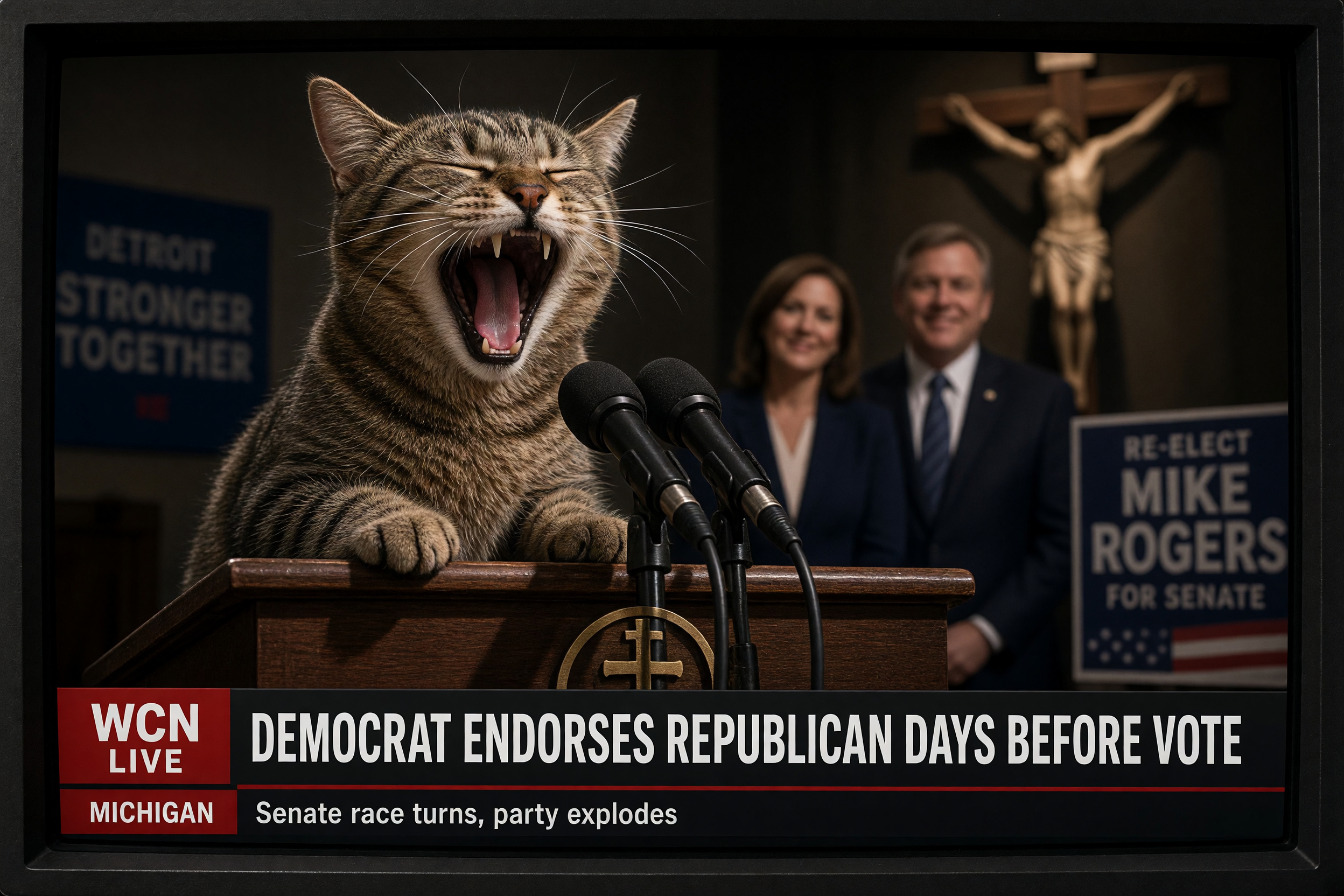
What Walter Read
Associated Press
Wire Service
Full Text
The Washington Post
Lean Left
Headline Only
BBC News
International
Full Text
Politico
Beat Reporter
Full Text
NPR
Lean Left
Headline Only
CNN
Lean Left
Full Text
NBC News
Lean Left
Full Text
Meta-Analysis Brief
Suggested post type: REPORT — At least three outlets with full body text (AP, BBC, NBC) plus Politico reported the same event with materially different emphasis — AP on Democratic turmoil and Stevens's demeanor, NBC on the 'antisemitic' ad framing and internal party fallout, BBC on betrayal and Senate math — making this a coverage-divergence story rather than a straightforward REPORT.
Consensus Facts
- Democratic Rep. Haley Stevens, who lost the Michigan U.S. Senate primary to Abdul El-Sayed, endorsed Republican nominee Mike Rogers on Sunday, Nov. 1, 2026.
- The endorsement came two days before Election Day on Tuesday.
- Stevens announced the endorsement in a video posted to social media, saying El-Sayed had told her she was no longer welcome in his campaign and that she should stay away, adding 'And he's right.'
- Stevens made the endorsement after attending a church service in the Detroit area alongside Mike Rogers.
- Stevens had been scheduled to appear at a joint unity event with El-Sayed (and others, including Rep. Jim Clyburn) on Sunday, but El-Sayed's campaign asked her to stay away.
- The dispute escalated over an outside/liberal-group ad critical of Israel; Stevens wanted El-Sayed to condemn it, and El-Sayed said he had nothing to do with its contents.
- El-Sayed dismissed the endorsement, telling reporters 'I don't think about Haley Stevens' and 'None of this matters.'
- Mike Rogers said he was 'honored' by Stevens's support.
- The seat is currently held by retiring Democratic Sen. Gary Peters, and the Michigan race is one of the most competitive contests that could determine control of the Senate.
- Stevens is a centrist, pro-Israel Democrat, while El-Sayed represents the party's left wing and is a critic of U.S. support for Israel.
- Members of Stevens's staff/team resigned following her announcement.
- Michigan Democratic Party chair Curtis Hertel condemned the move, stating Stevens is not and will not be a member of the Michigan Democratic Party.
- El-Sayed is a former Michigan public health official and the son of Egyptian immigrants; Rogers is an ex-congressman backed by President Donald Trump.
Disagreements
Characterization of the ad at the center of the dispute
NBC News: Describes the ad as one 'that Stevens said was antisemitic,' linking it to Stevens's framing.
BBC News: Describes it as 'a campaign advert from an outside liberal group that linked US support for Israel with high prices,' without the antisemitism label as a central descriptor.
Associated Press: Does not detail the ad specifically; frames tensions broadly around Israel and past remarks.
Stevens's stated rationale and demeanor
Associated Press: Emphasizes a 'disjointed' CNN interview in which she took long pauses, seemed to struggle, and described El-Sayed as increasingly angry; cites Debbie Dingell calling it 'one of the most painful interviews.'
NBC News: Presents her reasoning via the endorsement video, citing El-Sayed's ties to Hasan Piker and 'who we are as Michiganders is not hate.'
BBC News: Quotes her saying 'I don't belong in Abdul's campaign' and frames it around party betrayal and divisions.
Likely impact on the race
CNN: Frames it as an open question — 'Could her public decision shift the results?'
BBC News: Includes voter voices, some saying it is a betrayal and others (Rogers supporters) doubting it will change minds.
Framing Analysis
Associated Press
Leads on the shock to Democrats ('stuns Democrats,' 'extraordinary defection') and frames the story around party turmoil days before the election. Heavily features the aide resignation, the dueling church services, and a sympathetic-yet-critical portrait of Stevens as struggling and 'angry'-focused via her CNN interview and Dingell's reaction. Notes El-Sayed's prior controversies (synagogue-attack remarks, Hasan Piker) and the Black and Jewish voter enthusiasm concerns. Wire-neutral but emphasis is on Democratic dysfunction.
The Washington Post
Headline-only in dossier. The unique angle is Stevens's fiancé Jason Turkish as 'the unlikely player' — a framing no other outlet centers. Body text not retrievable, so the substance of that angle cannot be assessed.
BBC News
International framing with heavy emphasis on the 'party spat' and 'betrayal' language (quoting Schumer's 'despicable betrayal' and a Michigan voter's 'betrayal of the party'). Provides the most context on Senate math (net gain of four needed, five if Michigan lost), the swing-state history (last GOP win 1994), and 2028 presidential-primary implications. Includes on-the-street voter reactions and Trump's praise of Stevens as 'very brave.'
Politico
Specialized/insider framing that stresses its own scoop ('as POLITICO first reported') that El-Sayed's team asked Stevens to stay away. Leads on the 'seismic'/'stunning break' and the derailment of Democratic unity. Concise, process-focused on how the feud crescendoed over the weekend and the ad condition Stevens attached to the joint appearance.
NPR
Headline-only in dossier. Headline frames the act as Stevens 'spurning' El-Sayed. No body text to analyze.
CNN
Body text is largely an aggregation of election-night/video segments rather than a dedicated article. Frames Stevens's switch as an open question of impact ('Could her public decision shift the results?') and notes Rogers saying Stevens is 'welcome' at his election-night event. Most of the text concerns unrelated races, limiting substantive single-story reporting.
NBC News
Leads on the 'major shake-up' in a control-of-the-Senate race. Foregrounds Stevens's framing that the ad was 'antisemitic' and her invocation of Hasan Piker and 'hate.' Notably surfaces internal Democratic fallout — a subscriber item that House Democrats are weighing whether to 'banish' Stevens and Hertel's statement that she is not a party member. Credits its own Saturday reporting that El-Sayed's campaign asked her to stay away.
Primary Source Alignment
- No primary sources (e.g., Stevens's full endorsement video transcript, official party statements in full, or roll-call/filing documents) were provided in the dossier, so no direct report-versus-document comparison is possible.
- Stevens's endorsement video is quoted by multiple outlets (AP, BBC, Politico, NBC) with consistent core language ('said I was no longer welcome... And he's right... I am endorsing Mike Rogers'), but the full video is not in the dossier for verification.
Missing Context
- No outlet in the dossier provides polling data quantifying how close the Michigan race actually is or whether Stevens retains measurable influence over voters.
- The exact content, sponsor, and wording of the disputed 'outside liberal group' ad is not reproduced in any available body text, making it impossible to independently assess whether it was 'antisemitic' (NBC/Stevens framing) or simply linked Israel support to prices (BBC framing).
- El-Sayed's side of the sequence — whether and exactly how his campaign told Stevens to 'stay away,' and in what words — is reported via campaign/POLITICO/NBC sourcing but not from a primary document or direct El-Sayed statement confirming the specific instruction.
- The Washington Post's distinctive angle — the role of Stevens's fiancé Jason Turkish — is headline-only and unretrievable, so the dossier cannot explain what role he allegedly played.
- No outlet details whether Stevens faces formal consequences (the NBC 'banish' item is a subscriber headline without body detail).
- Only three outlets (AP, BBC, NBC) plus Politico have substantial body text; NPR and The Washington Post are headline-only and CNN's text is largely unrelated aggregation, so single-outlet details (e.g., AP's CNN-interview demeanor description, NBC's Piker emphasis) should be read as single-source, not consensus.
- No evidence of instruction-injection attempts was found in any article body.
Verification Gate Results
PASSED
All verification checks passed.
Draft Analysis
ESCALATION
- legal_status (major) — The draft states as fact that Stevens was expelled when the sources only indicate Democratic disapproval and at most a consideration of banishment—no actual expulsion is reported.
- attribution (minor) — The draft's framing as 'told her to stay away' matches the substance of source reporting, though 'asked' is the more precise verb used in the bodies.
Story Selection
15 candidates detected, 13 passed triage
Selected: The unlikely player in contentious Michigan Senate race: Stevens’s fiancé - The Washington Post
Source: news_fetcher