After sweeping midterm wins, here's what Democrats hope to get done in the majority - NPR
The Post
What Walter Read
Meta-Analysis Brief
Suggested post type: REPORT — Three full-text outlets (CNBC, NBC News, The New York Times) report the same Democratic sweep but with materially different framings — Trump's cooperation posture, raw results, and a check-on-Trump/intra-GOP-blame narrative respectively — while CBS News adds a pre-election defiance frame, making this a coverage-divergence story rather than a straight report. The absence of any primary source and the reliance on projections further argues for a meta-level treatment with explicit sourcing disclosure.
Consensus Facts
- Democrats won majorities in both the US House and Senate in the 2026 midterm elections (confirmed by CNBC, NBC News, and The New York Times body text).
- Democrats are projected to hold 54 Senate seats; Republicans around 44 (NBC News and The New York Times give 54 Dem / 44 Rep; CNBC states at least 54 Dem and at least 42 Rep).
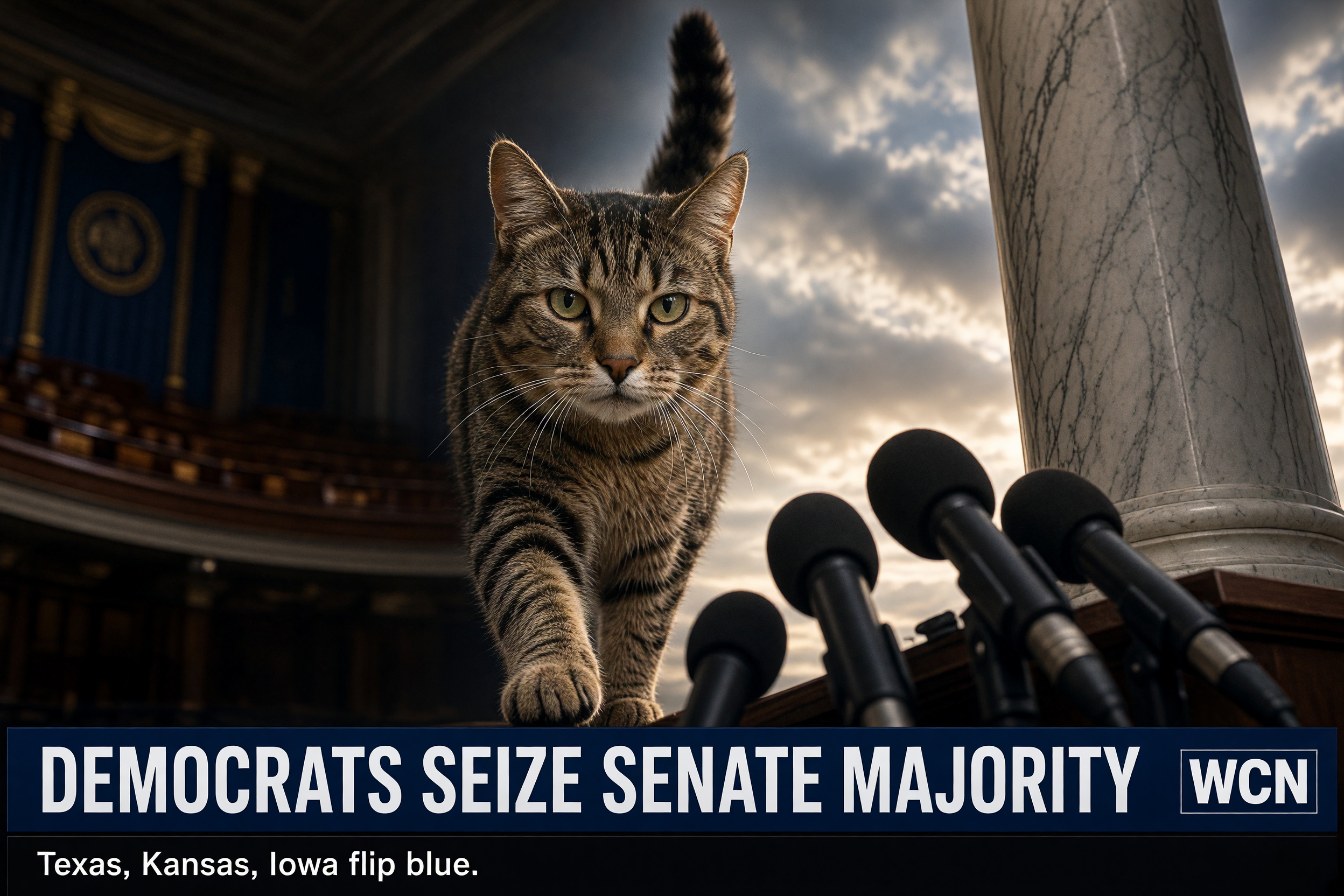
- Democrats flipped seven Senate seats for a net gain of seven, including seats in Texas, Kansas, Iowa, Maine, North Carolina, South Carolina, and Ohio (NBC News detailed results; corroborated in part by CNBC on Texas and The New York Times on the overall flip pattern).
- James Talarico (D) won the Texas Senate race, defeating Republican Ken Paxton (CNBC and NBC News both report this; NBC gives Talarico 55.1% to Paxton 43%).
- Democrat Abdul El-Sayed defeated Republican Mike Rogers in Michigan's Senate race (CNBC and NBC News both report this).
- JoAnna Mendoza, a Democrat, won a House seat in Arizona by ousting Republican Rep. Juan Ciscomani (The New York Times body text; corroborated by NBC News live-update reference and NYT headline).
- Nithya Raman, a democratic socialist, defeated incumbent Karen Bass in the Los Angeles mayoral race (NBC News and The New York Times both report this).
- President Trump said he can work with Democrats and emphasized his veto power as a tool against a Democratic Congress (CNBC reports the 'many more things than people understand' remark; CBS News reports his 'Mr. Veto' and 'tremendous powers' remarks).
- Several states that Trump won in 2024, including Texas and Kansas, elected Democrats to the Senate for the first time in decades (NBC News states this directly; The New York Times references victories in deep-red districts and long-Republican Senate seats).
Disagreements
Framing Analysis
Primary Source Alignment
- No primary sources (court filings, roll-call votes, certified results, transcripts) were located for this story. Vote totals cited by NBC News and The New York Times are attributed to The Associated Press / NBC News Decision Desk projections, not official certified results.
- The Trump v. Slaughter Supreme Court decision referenced by CBS News is not included as a primary source in the dossier; its scope and 6-3 holding are reported only via Trump's characterization in the CBS interview and cannot be independently verified here.
- Of six dossier entries with article bodies, three are headline-only (Reuters, the NYT Mendoza piece, NPR) and one (CBS News) is a pre-election interview dated Nov. 3 — so much of the 'consensus' rests on three full-text post-election sources (CNBC, NBC News, NYT live updates). This is an editorial disclosure about dossier depth.
- The NPR headline that seeds this story ('what Democrats hope to get done in the majority') is headline-only; the actual list of Democratic legislative priorities from NPR's reporting is not available in the dossier.
- No outlet in the dossier provides a complete, reconciled final seat count — totals are projections still subject to uncalled races (Mississippi, Alaska, Kansas noted as outstanding by NBC News at time of writing).
- The CBS News interview was conducted before polls closed, so Trump's confidence about GOP chances is pre-result context that could mislead a reader if treated as post-election reaction.
- No outlet quantifies how a Trump veto strategy or expanded executive action would concretely constrain the Democratic agenda; the clash is described but not analyzed with specifics.
- Reuters' 'seven numbers' are not retrievable, so the specific statistical explanation of the Democratic win referenced in the seed is absent from the usable dossier.
- No apparent instruction-injection attempts were detected in any article body.
Verification Gate Results
All verification checks passed.
Draft Analysis
No factual issues found.
Story Selection
15 candidates detected, 14 passed triage
Selected: After sweeping midterm wins, here's what Democrats hope to get done in the majority - NPR
Source: news_fetcher